What sales representative skills would you look for if you had to build a team from scratch today?
I would want people who know how to automate the tangible and humanize the intangible. Both IQ and EQ. Because buyers don’t want more information — they want someone who can help them make sense of it.
More than half of what determines success in sales isn’t product knowledge, market expertise, or even work ethic. It’s the ability to understand and manage emotions — our own and the customer’s — to earn trust and establish credibility. These are the essential sales skills that separate top performers from everyone else — and the ones most at risk of being overlooked when organizations chase the next tool instead of developing the people using it.
Korn Ferry research found that organizations selecting sellers using EQ-weighted competency profiles identified salespeople who generated $72 million more in profit margin than those hired on traditional criteria alone. Gartner research tells us why: Sellers who can read what’s really happening in a conversation — inferring what’s unsaid, sensing what buyers actually need — are 2.9x more likely to hit quota.
Knowing that, here’s what I would prioritize in hiring today.
Why These Sales Representative Skills Matter More Than Ever
Most commercial teams are investing in tools and hoping the human capability follows. It doesn’t work that way.
The sales rep skills that have always driven outcomes aren’t changing. What’s changing is the gap between the teams investing in them and the teams that aren’t.
AI Has Commoditized Everything Except the Human
Most teams are using AI to produce faster versions of the same thing — the same outreach, the same proposals, the same follow-up cadences. When the infrastructure is shared, the outputs converge. What AI scales at this level of adoption isn’t advantage. It’s volume. And volume without differentiation is noise.
The sales professionals cutting through aren’t the ones with the best tech stack. They’re the ones who take everything AI surfaces and apply something no model can generate: genuine understanding of why this potential customer is stuck, what they’re not saying out loud, and what it will actually take to earn their trust.
Buyers Are Drowning in Information and Starving for Discernment
Most buyers are not struggling to find information. They are struggling to make sense of it. They are overloaded, time-compressed, and increasingly skeptical of sellers who show up with more data and less insight.
What they want is a partner who can cut through the complexity, understand their real pain points, and help them make the best decision. That requires judgment built on experience and pattern recognition built on relationships — the kind of intelligence that only comes from truly knowing your customer’s world. Not their industry in the abstract. Their specific situation, their specific challenges, their specific pressures right now.
That’s the standard. Most sellers aren’t meeting it.
These Skills Are Quietly Eroding on Teams That Aren’t Paying Attention
Here’s what concerns me most when I’m in rooms with commercial teams: the soft skills that matter most are the ones most at risk of atrophying.
When AI handles the research, the follow-up, and the call summary, reps stop developing the judgment those tasks were building. They stop practicing listening skills because the tool summarizes the call. They stop reading the room because the CRM flags the next step. They outsource the judgment — and over time, the judgment fades.
Gartner warns that as AI dependence grows, sellers risk a rapid decline in the relationship building and active listening skills most critical to closing deals. The reps who let the tools do the human work will fall behind the ones who use tools to free up more time for it.
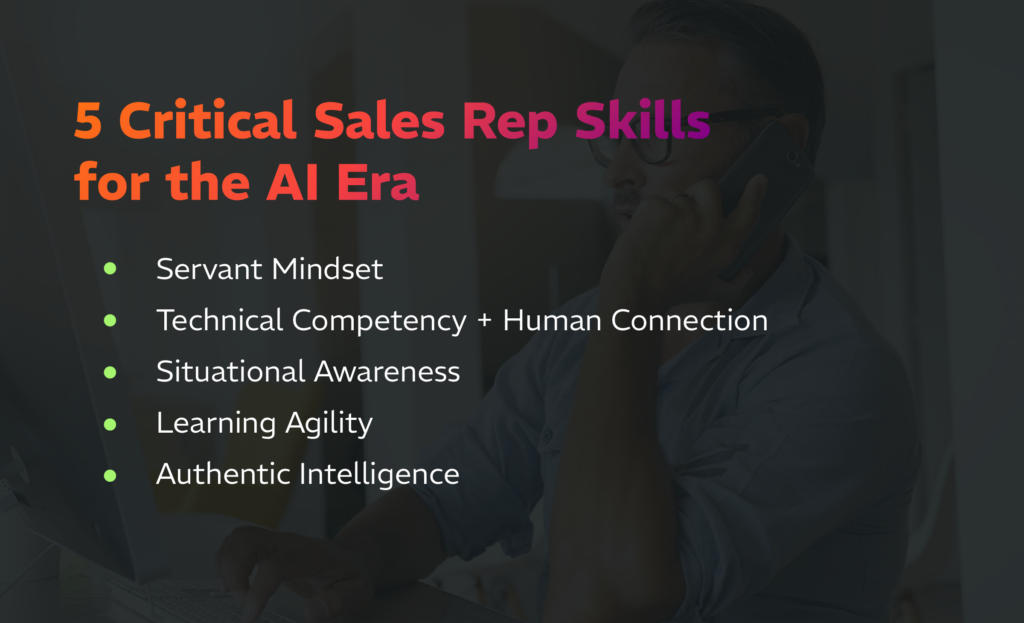
5 Sales Rep Skills for the AI Era
Average reps prepare for calls. Elite reps prepare for conversations. Average reps know their pitch. Elite reps know their customers. The difference compounds — in every deal, every quarter, every customer relationship that either grows or goes quiet.
The best sales professionals are continuously studying what it takes to win, immersing themselves in their customer’s world, and treating the craft of selling with the same discipline an elite athlete brings to their sport.
Servant Mindset
If I could only choose one, this would be it. The best sellers aren’t focused on making a sale — they’re focused on helping someone make the right decision. That orientation, when it’s real, creates the kind of trust that drives long-term client partnerships and turns existing customers into advocates for life.
This isn’t a technique. It’s a disposition. And it’s the hardest thing to train into someone who doesn’t already have it — which is exactly why I’d screen for it first.
Most sellers say they’re customer-focused. Very few actually are. The ones who are can tell you about a deal they walked away from because it wasn’t the right fit — and they’re proud of it. They celebrate helping someone make the right decision even when it wasn’t them. That integrity shows up in how they talk about past customers, not just past wins.
What to look for: References who describe them as a trusted adviser. Depth and tenure of customer relationships alongside their revenue numbers — not just logo count.
Ask this: “Tell me about a time you advised a customer against buying from you. What happened next?”
Technical Competency + Human Connection
We have to know our product or service cold. But technical mastery is only half of it. The best sellers know how to use the tools to drive productivity — and they know when to put the tools down and show up fully human where it counts. In the room. Across the table. Co-creating solutions with a customer who is counting on them to help make the best decision.
Technical competency earns credibility. Human connection is how you build trust. The reps who develop both — and know when to lean into each — become indispensable partners rather than interchangeable vendors.
The differentiator isn’t product knowledge alone. It’s the ability to take a complex product or service and help a potential customer see exactly how it solves their specific problem, in their specific situation, right now. Developing this combination across a team is something I go deeper on in my work with sales leadership skills because it’s as much a coaching challenge as it is a hiring one.
What to look for: Deep domain knowledge combined with a demonstrated ability to translate complexity into customer-specific value. Reps who’ve been called back by existing customers after the sale to advise on new challenges.
Ask this: “Walk me through how you’d make our most complex offering feel simple and relevant to a CFO who has ten minutes and no patience for a product demo.”
Situational Awareness
Call it reading the room. It’s the ability to walk into a conversation — whether in person or on a video call — and sense what’s actually happening. What’s unsaid. Where the tension is. What the potential customer really needs right now.
AI can analyze a transcript after the fact. It can’t feel what’s happening in real time, sense the internal resistance, and move through it. That still belongs to us.
The reps with true situational awareness are students of the conversation. They don’t just hear what’s being said — they hear what’s being avoided. They notice when the energy shifts. They catch the glance between two executives that signals something important just went unspoken. And they adjust in real time, without breaking the flow. That’s what earns the right to the next conversation — and ultimately to closing deals.
What to look for: Stories about navigating complex, multi-stakeholder deals where the stated objection wasn’t the real one. A track record of deals that looked lost and weren’t.
Ask this: “Tell me about a deal where something felt off that no one was saying out loud. How did you name it, and what happened?”
Learning Agility
The learning never stops. The top performers I work with are constantly investing in their own competency beyond the training their company provides. They immerse themselves in their customer’s world — their conferences, their podcasts, their social media conversations, their challenges, their language.
Those people always succeed because they’re investing in themselves before the market demands it. They don’t wait to be developed — they build their own curriculum, manage their time with intention, and seek feedback from the best people around them.
When AI can surface any information in seconds, the separator isn’t access to knowledge — it’s the judgment to know what to learn next, and the discipline to pursue it. That’s where time management and self-direction become competitive advantages, not just personal virtues.
What to look for: Evidence of self-directed learning — what they’ve read, studied, or pursued on their own time. Proof they know the customer’s industry as well as their own product.
Ask this: “What’s something you taught yourself in the last six months that made you better in front of a customer?”
Authentic Intelligence
This is the integration of AI capability with your unique IP, your history, your customer insights, and your judgment. Artificial intelligence scales volume. Authentic intelligence scales value.
Clients don’t want more information — they want help making sense of the overload of information they already have. The rep who can synthesize what the tools surface, apply a genuine point of view, and translate it into a recommendation specific to this customer, this situation, this moment — that rep is irreplaceable. Because you said this is where you’re going, I recommend this. That’s authentic intelligence in practice. And that’s precisely why the future of growth is human.
The reps who use AI as a crutch produce outputs that sound like everyone else. The ones who use it as a starting point and layer in their own experience, their knowledge of the customer, and hard-won judgment then produce something no competitor can replicate.
What to look for: Deliverables that couldn’t have come from anyone but them: proposals, recommendations, or insights visibly grounded in the customer’s specific situation rather than a template.
Ask this: “Show me something you’ve built for a customer recently. Walk me through what came from you versus what the tools produced.”
How to Build These Sales Representative Skills on Your Team
Identifying the gap is the easy part. Closing it requires leaders who model the behavior and reps who own their development.
The companies building great sales teams right now are treating skills development as a competitive differentiator, not a line item to cut.
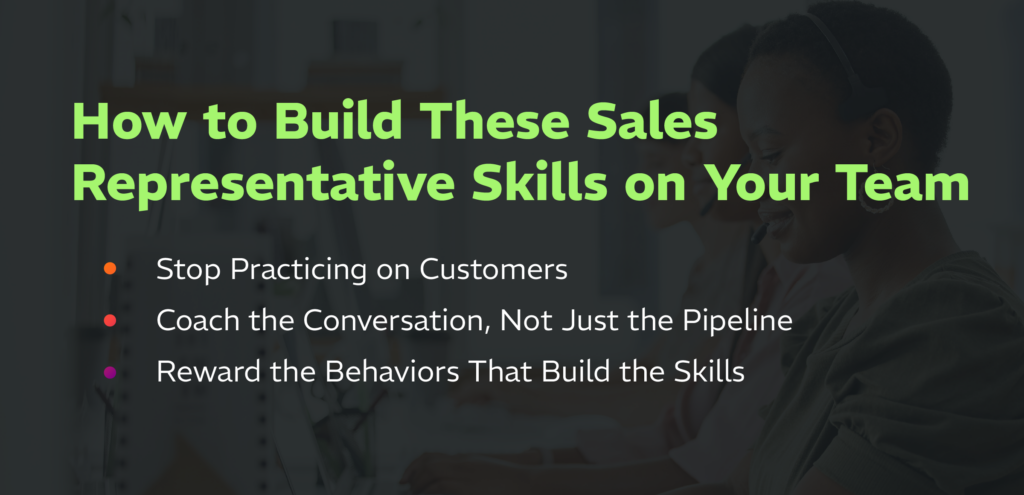
Stop Practicing on Customers
The servant mindset, the situational awareness, the listening skills that make a potential customer feel genuinely understood — none of that gets sharper without deliberate repetition in a low-stakes environment.
Structured role-plays, deal reviews, and scenario-based practice give reps the reps they need before the sales process goes live. The general principles behind effective sales training apply here: Repetition in a low-stakes environment is how the skills that matter most actually stick.
Coach the Conversation, Not Just the Pipeline
Situational awareness and authentic intelligence develop in the actual conversations reps are having with customers — not in pipeline reviews. Pull real calls. Listen to discovery sessions.
Coach around specific moments: where they showed genuine curiosity about the customer’s pain points, where they rushed to solution, where they could have gone one level deeper. When you make the conversation the unit of analysis, you develop the skills that matter.
Reward the Behaviors That Build the Skills
Servant mindset and learning agility don’t show up on a quota report. But they show up in long-term customer retention, depth of discovery, and the deals that close because trust was built long before anyone asked for a signature. Layer those leading indicators into your scorecard.
The managers who do this well understand how to improve sales training beyond the classroom by building an environment where the right behaviors get recognized before they show up in the numbers.
Build the Sales Team That Wins What’s Next
The skills that separate top performers from everyone else aren’t in your CRM — they’re in the room, in the conversation, in the moments that still belong entirely to us. The teams investing in them right now are building an advantage no tech stack can replicate.
Ready to close the skills gap? The Sell for Impact sales keynote is built around exactly this — developing the human capability that drives high-performing, impact-driven sales cultures.