I've been in rooms where you could feel the lack of trust — arms crossed, questions loaded, walls up before the conversation even started. Buyer skepticism isn't new. But learning how to build trust with clients — and make it last — has never been more urgent.
AI may be making it worse. Forrester research found that nearly all business buyers — 94% — now use AI during the buying process. And while AI-powered search tools offer speed, efficiency, and convenience, especially in the early stages of the sales process, research suggests that it's also making many people less confident in their decision.
In fact, by 2030, Gartner predicts that 75% of B2B buyers will prefer sales experiences that prioritize human interaction over AI, prompting organizations to rethink how they structure their sales teams and customer engagement strategies.
Buyers don't need more information. They need to feel like they can trust the person giving it to them.
Here's how to become that person.
2 Kinds of Trust — and Why Most Sellers Only Build 1
Not all trust is the same. Understanding the difference is where most sellers fall short.
Buyers today evaluate the customer experiences sellers deliver just as carefully as the solutions themselves. They're asking: is this person credible? Do they understand my business? Do they actually care about my outcome?
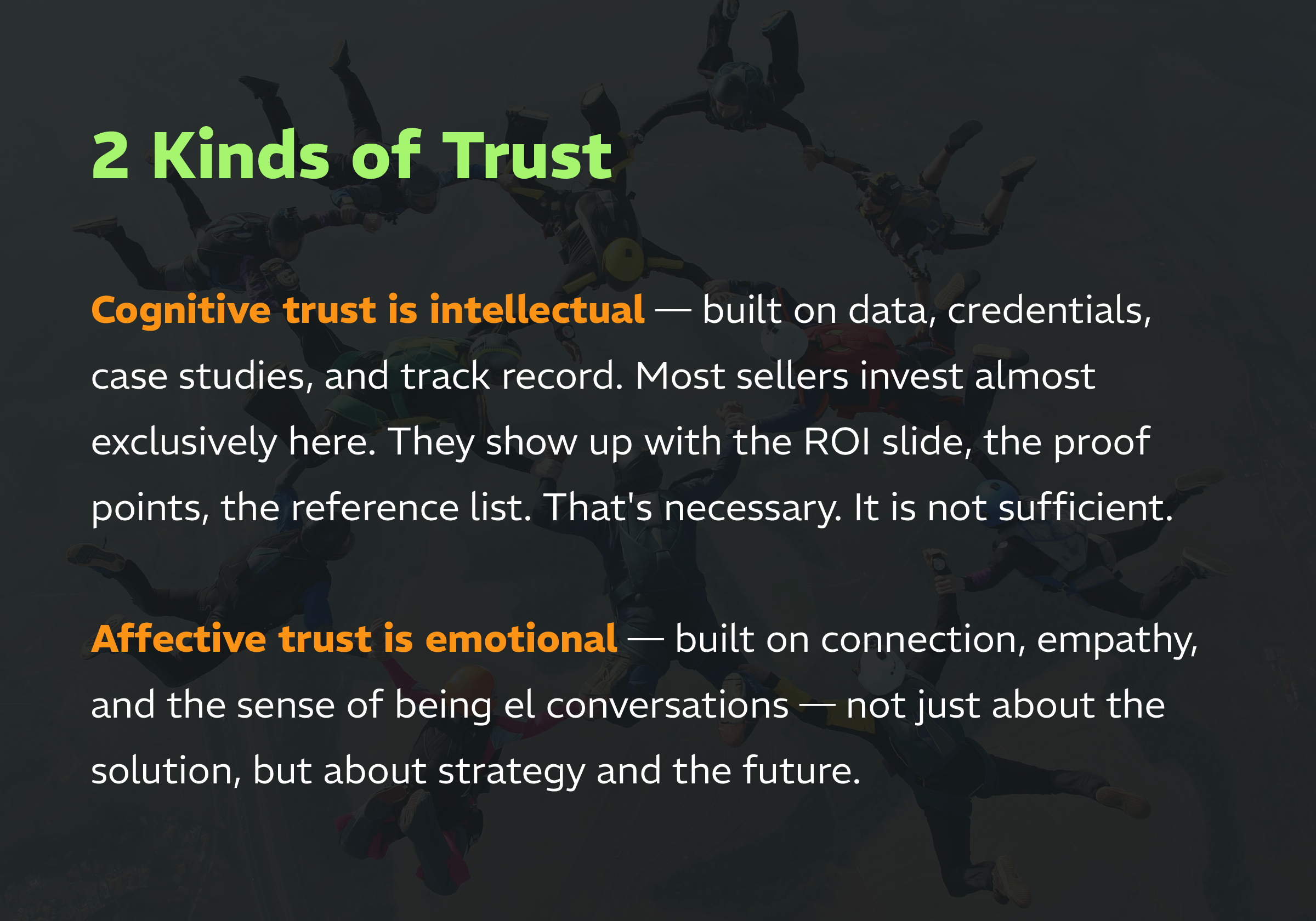
Cognitive trust is intellectual — built on data, credentials, case studies, and track record. Most sellers invest almost exclusively here. They show up with the ROI slide, the proof points, the reference list. That's necessary. It is not sufficient.
Affective trust is emotional — built on connection, empathy, and the sense of being genuinely understood. It's about creating positive experiences in every touchpoint — the kind buyers remember long after the meeting ends. A core human need is to feel seen, heard, and valued. When buyers experience that from a seller, the dynamic shifts. The walls come down. The conversation opens up. The partnership becomes possible.
Build both, and you earn the right to have high-level conversations — not just about the solution, but about strategy and the future.
|
Cognitive Trust |
Affective Trust |
|
|
Built on |
Data, credentials, track record |
Connection, empathy, understanding |
|
How it shows up |
ROI slides, case studies, proof points |
Listening, questions, genuine attention |
|
Buyer feels |
Confident in the solution |
Seen, heard, and valued |
|
Risk if missing |
Buyer can't justify the decision |
Buyer never fully opens up |
|
Earned through |
Expertise and evidence |
Consistency and emotional intelligence |
Why Trust Is the Foundation of Every Client Relationship
Every seller wants to gain customer trust and build customer trust that lasts. But most treat it as a byproduct of a good pitch — something that happens if the product is strong and the deck is polished. It isn't. Trust is the foundation. Everything else is built on top of it.
Today's clients expect more than a capable solution — they expect a seller who understands their world and has their best interests in mind. Without that, deals stall and relationships never take hold. When trust is present, strong relationships form and everything accelerates. Close rates improve. Deal velocity picks up. And buyers start making introductions you couldn't get on your own. The long-term relationships that generate lasting growth — the ones that produce referrals, renewals, and expansion — are all downstream of trust.
The bottom line: trust isn't a soft skill. It's the hardest and most consequential competency a seller can develop.
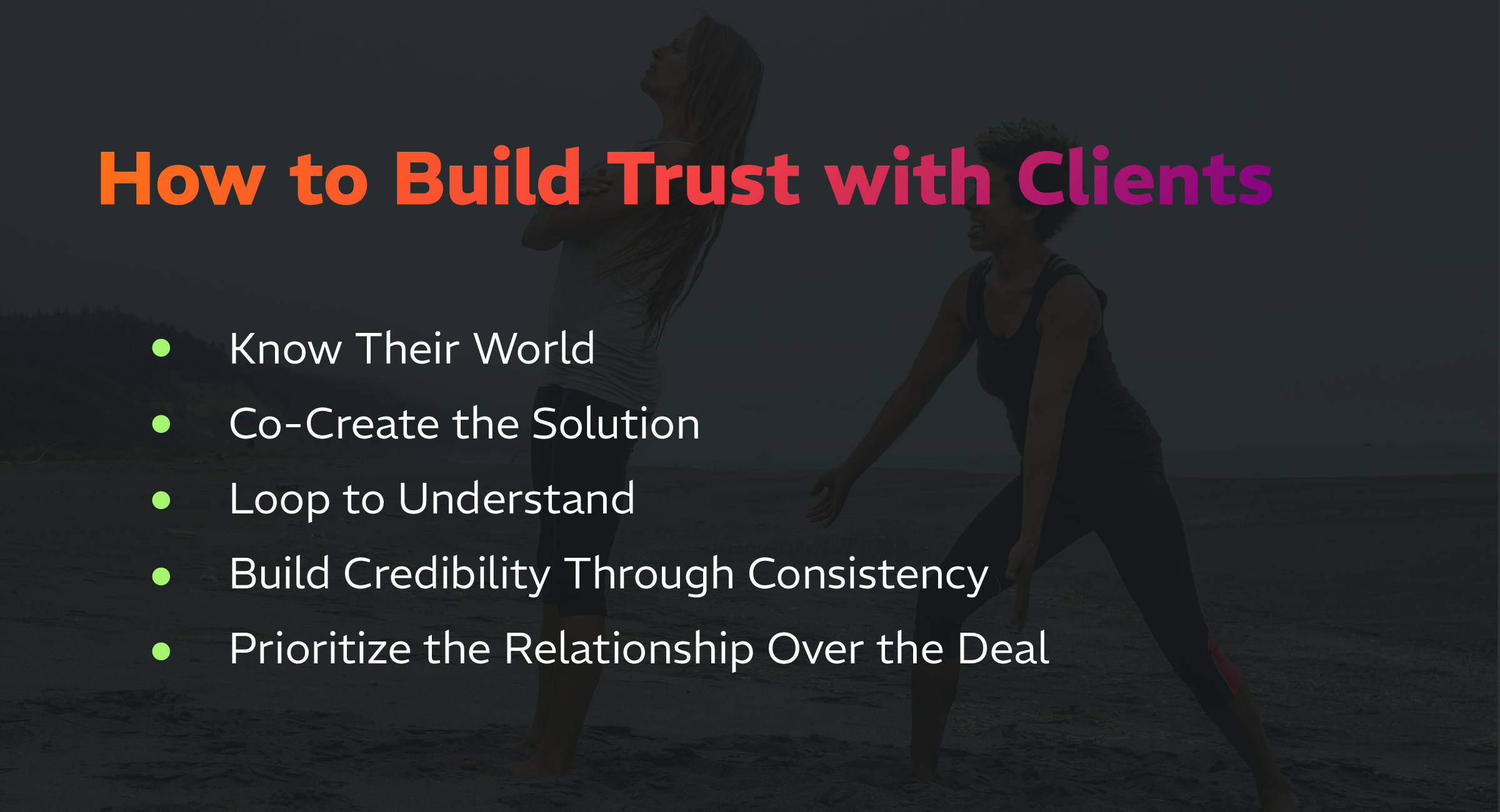
How to Build Trust with Clients
So which of the following helps build trust and confidence among prospective buyers? The research — and what I've witnessed in rooms with the world's top sales teams — points to five practices that consistently separate trusted sellers from the rest.
Know Their World
Most sellers invest heavily in product knowledge — in knowing their product or service inside out — and almost nothing in customer knowledge. Real trust starts with understanding the problems your buyer is actually trying to solve — their priorities, their constraints, their definition of success. The best way to demonstrate that you can help is to prove that you understand before you ever propose anything. That's where trust begins.
That understanding has to be specific. Not general knowledge of a buyer's industry — knowledge of their business and the particular challenges they're working through right now. Before clients understand the value you can bring, they need to feel that you understand them. Pre-call planning is where this work happens. Sellers who invest in it consistently earn trust faster than any pitch deck can deliver.
Co-Create the Solution
Trust accelerates when buyers feel like partners, not prospects. When I've done the work to understand a client's world, I introduce my recommendation with a specific frame: "Because you said… I would recommend…"
That framing matters. It signals that your solution isn't a product you're pushing — it's a response to what they told you. The solution reflects their language, their priorities, their definition of success. It stops being your pitch and starts being their plan. Partnership creates ownership. Ownership accelerates commitment.
Loop to Understand
Most sellers think listening is about being quiet. It isn't. It's about creating the conditions for a buyer to feel genuinely heard — and that requires a deliberate sequence.
I use a framework I call "looping to understand." Ask an open-ended question. Probe twice based on what you hear. Then summarize what you understood before moving forward. It sounds simple. But when you execute it consistently, it changes the entire dynamic of a sales conversation — because buyers stop feeling like they're being qualified and start feeling like they're being understood.
That distinction matters more than most sellers realize. Affective trust is built in these moments. When a buyer feels seen and heard, they stop evaluating your credentials and start imagining the relationship. Paying close attention to customer feedback — both what buyers say and what they leave unsaid — is where that trust is earned. Nothing delivers it faster than intellectual honesty about what you know and what you don't.
Build Credibility Through Consistency
Trust is built in the small moments. Meeting deadlines. Honoring commitments. Showing up prepared. Buyers are evaluating you alongside your product — and what they're really asking is: can I depend on this person?
That evaluation starts long before the first meeting. Buyers do their homework — they check your social media and ask their network before they ever get on a call. Consistent branding — showing up the same way online and in every client interaction — reinforces the trust you're building in person. And customer service doesn't end at the close. Every post-sale interaction is an opportunity to deepen the client relationships you've built.
The sellers with the most loyal customer base treat every small promise like it matters. Predictability reduces risk. Every time you follow through, you're building trust. Every time you don't, you're spending it.
Prioritize the Relationship Over the Deal
The sellers who build the deepest trust are willing to say the hard thing — "I don't think this is the right fit for you right now." Being open and honest — even when it costs you the deal — is the move that earns the relationship.
When someone trusts you, they feel safe around you. They believe you have their best interests in mind. That's when the real partnership begins — when they welcome the honest conversation and start thinking about what else you could do together. That's how you build long-term clients — the ones who refer you without being asked and renew without a negotiation. High-trust client relationships become the catalyst for referrals, renewals, and growth that doesn't require a pitch. You will never maximize your potential in the absence of trust.
Build Trust with Clients — and Make It Last
The most sustainable sales strategy isn't a better pitch or a smarter sequence. It's becoming the person your buyer trusts.
When you invest in both cognitive and affective trust — when you know their world and show up with consistency — you stop selling and start advising. The deals get easier. The relationships get stronger. And your clients start opening doors you can't open yourself. That's the foundation of long-term success in sales — not the single deal, but the partner relationship that compounds over years.
That's what it means to build trust with clients. And that's what it means to sell for impact.
Want to help your sales team master trust-based selling? Learn more about our sales keynote and bring this framework to your next SKO or sales meeting.