The old playbook of sales growth strategies was built on volume and pressure. Ramp up the activity, turn up the urgency, and people will move through the sales funnel from sheer force of will. That approach fails in a market where buyers are informed, risk-aware, and reluctant to engage with anyone who feels like a transaction instead of a partner.
Today, the most effective B2B sales growth strategies are human-centered. They treat increasing revenue as the outcome of how well you serve customers and support your people, not just how hard you chase a number.
When purpose, people, and strategy are aligned, organizations earn the right to grow. Reps show up as advisors instead of vendors. Customers stay, expand, and advocate. Performance compounds instead of resetting every quarter. That is the foundation of sustainable sales growth.
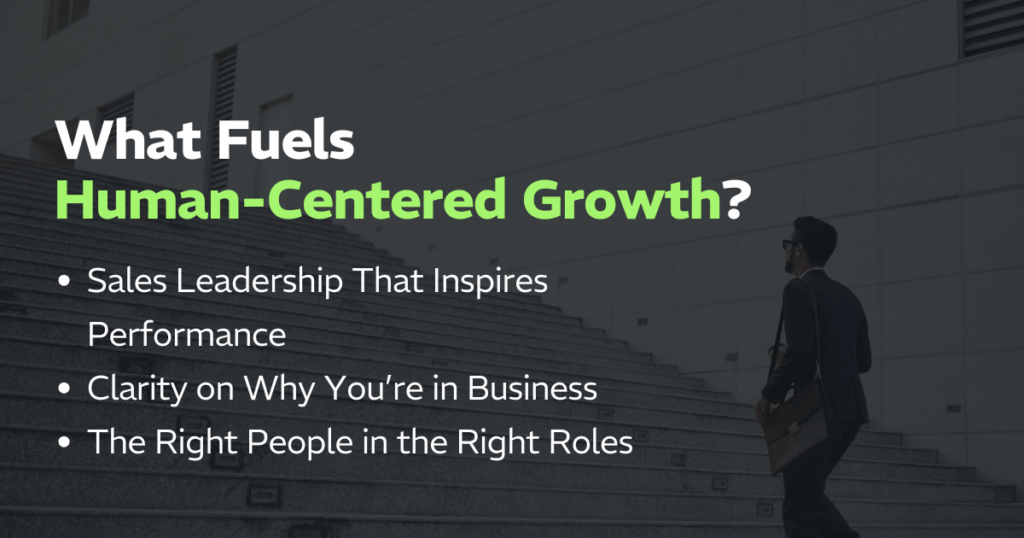
What Fuels Human-Centered Growth?
Human-centered growth starts with who you are, how you lead, and what it feels like to work with you. The most B2B effective sales growth strategies are built on leaders who do the inner work, teams that are connected to purpose, and customer relationships grounded in trust.
Sales Leadership That Inspires Performance
Sales leaders who do the inner work by clarifying their values, managing their own reactions, and staying curious under pressure create an environment where people can perform at their best.
They model preparation, presence, and honesty. That kind of human-centered sales leadership is what ultimately unlocks hyper sales growth because people are willing to bring their best work to a leader they trust.
Clarity on Why You’re in Business
Who are you here to serve? What problems are you committed to solving? How do you want customers and employees to feel after they interact with you? When that purpose is clear and lived, it gives meaning to every sales target and every strategic decision.
People want to contribute to something that matters. When your team understands why the business exists and how their work advances that mission, they engage differently. Activity turns into commitment. Commitment turns into performance. And performance, aligned with purpose, is the real engine for sales success.
The Right People in the Right Roles
The engine of any growth strategy is talent.
That starts with how you hire and promote. Look for curiosity, coachability, and a genuine commitment to serving the customer. Then surround those people with clear expectations, practical tools, and support that removes friction instead of adding it. The discipline of how to build a high-performing team is less about the org chart and more about designing an environment where people can consistently do their best work.
Front-line sales professionals and sales managers carry a disproportionate share of your growth agenda. Coaching, mentoring and ongoing development ensure the people responsible for your most important customer conversations can show up prepared, confident, and credible. When individuals are set up to succeed, their success scales across the organization and helps accelerate sales growth.
Sales Growth Strategies vs. Sales Growth Tactics: Why the Distinction Matters
If your team can’t explain your sales growth strategy in a sentence, you don’t have a strategy. More likely, you have a collection of tactics.
- Sales growth strategies are the big-picture, long-term decisions that determine where we’re going and why. It’s the blueprint. Strategy is deciding to expand into a new market, focus on a priority customer segment, or emphasize a new service. It also includes choices about your go-to-market mix: where you’ll lean into sales-led enterprise coverage, where product-led growth makes sense, how account-based/ABM programs and partner or ecosystem-led motions contribute to the number.
- Sales growth tactics are the plays we run in the moment. The emails we personalize, the demos we schedule, the sequences we build for ABM accounts, the partner co-selling campaigns we launch, the in-product prompts we test in a PLG motion. They are the daily activities of sales representatives and GTM teams that help us hit near-term sales goals. Tactics are measurable, flexible, and they change fast, but they should always be in service of the larger strategy.
Without strategy, we’re busy but not effective. Without tactics, the best strategy stays stuck on the whiteboard.
Top Sales Growth Strategies That Work Today
The most effective sales growth strategies are clear, intentional choices about where growth will come from and how your team will win. They align your GTM model around the customers who matter most, the problems you are best positioned to solve, and the motions that let your people do their best work.
Double Down on Your Core ICP
Focus resources on the segments and use cases where you consistently win and earn customer loyalty. A sharper ideal customer profile and cleaner territory and coverage design help you avoid chasing volume for its own sake and instead drive efficient net-new growth where fit, value, and retention are strongest.
Build an NRR-Led Land-and-Expand Engine
Treat existing customers as the primary growth engine. Align customer success, account management, and sales around expansion pipeline, multi-product penetration, and net revenue retention as north-star metrics. When growth comes from deeper impact inside your current accounts, you create more stable, predictable momentum and a healthier business.
Move Up-Market
Shift the mix toward larger, more complex deals by moving deliberately into mid-market or enterprise segments. Pair focused ABM/ABX programs, executive-to-executive engagement, and more robust solution packaging so your go-to-market motion matches the way bigger customers buy. The key is to move up-market with clarity and readiness, not just ambitions.
Run a Verticalized Play
Go deep where you can matter most. Build dedicated plays for priority industries (healthcare, financial services, manufacturing, etc.) with tailored messaging, proof points, and seller specialization.
Vertical focus helps your team quickly learn how to speak the customer’s language, anticipate their challenges, and earn trust faster, which is a powerful accelerator of B2B sales growth.
Expand Geographically with Local Ownership
Enter new regions with a localized GTM strategy: regional leadership, the right partners, and credible field presence. The goal is to replicate what already works in your core markets while respecting local nuance in how customers buy.
Grow Through Portfolio and SKU Expansion
Increase wallet share by adding adjacent products and services that solve more of the customer’s problems. Support that with structured cross-sell and upsell programs into the installed customer base and target accounts so portfolio expansion feels like customer service not pitching.
Optimize Packaging and Pricing Models by Stacking Value
Evolve pricing and packaging—tiers, usage models, and bundles—to create more value. A thoughtful monetization strategy lifts ARPU and deal quality without relying solely on more early stage leads generated.
Lean Into Ecosystem- and Partner-Led GTM
Use strategic alliances, channels, and marketplaces as a force multiplier. Design clear partner plays for co-marketing, co-selling, and co-delivery so partners extend your reach, increase sales, and open doors even your top sales performers can’t do on their own.
When you treat partners as an extension of the team, ecosystem-led growth becomes a strategic asset, not a side project.
Layer PLG with a Sales-Assist Motion
Use product-led motions (trials, freemium, self-serve, in-app onboarding) to generate qualified usage and buying signals. Then layer in sales-assist and enterprise coverage to convert and expand the right accounts. Done well, PLG doesn’t replace your sales reps; it gives them warmer, more informed opportunities and a clearer path to expansion.
Build a Customer-Obsessed Retention and Advocacy Program
Treat onboarding, adoption and outcomes as core growth levers. Invest in customer experience and advocacy so your best customers renew, expand, and influence peers in your target accounts. When customers feel seen, supported, and successful, they become your most credible and scalable sales asset.
Most enterprise sales organizations run a mix of these strategies, with one or two being the main drivers. Choose the few that best match your purpose, your product, and your people and execute them with clarity and consistency.
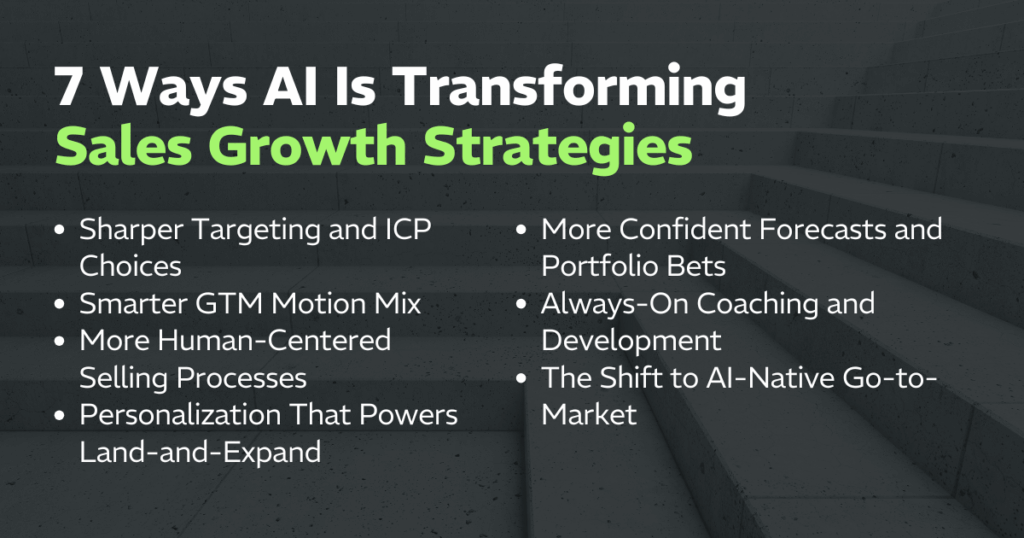
7 Ways AI Is Transforming Sales Growth Strategies
AI is turning sales growth strategies from opinion-driven bets into data-driven systems that help leaders prioritize the right accounts, messages, and motions at scale.
Sharper ICP Definitions
AI is changing how growth teams define and prioritize their ideal customers. Instead of guessing which segments will drive the next stage of growth, AI-powered models analyze behavior, firmographics, and intent signals to surface high-value segments and look-alike accounts.
That makes strategic choices, such as moving up-market, verticalizing your GTM, or doubling down on a specific ICP, less about gut feel and more about evidence. Research from ICONIQ has found leading growth companies are already using AI this way to refine who they go after and where they expect durable growth to come from.
Smarter GTM Motion Mix
AI is also influencing which go-to-market motions we run, and in what mix. By showing where inbound, outbound, PLG, and partner-led deals actually originate and progress, AI gives leaders a clearer view of which motions are truly driving opportunity creation and conversion.
That’s pushing many organizations toward more precise, intent-driven outbound, ABM/ABX, and product-plus-sales-assist models, rather than broad “spray and pray” campaigns.
More Human-Centered Selling Processes
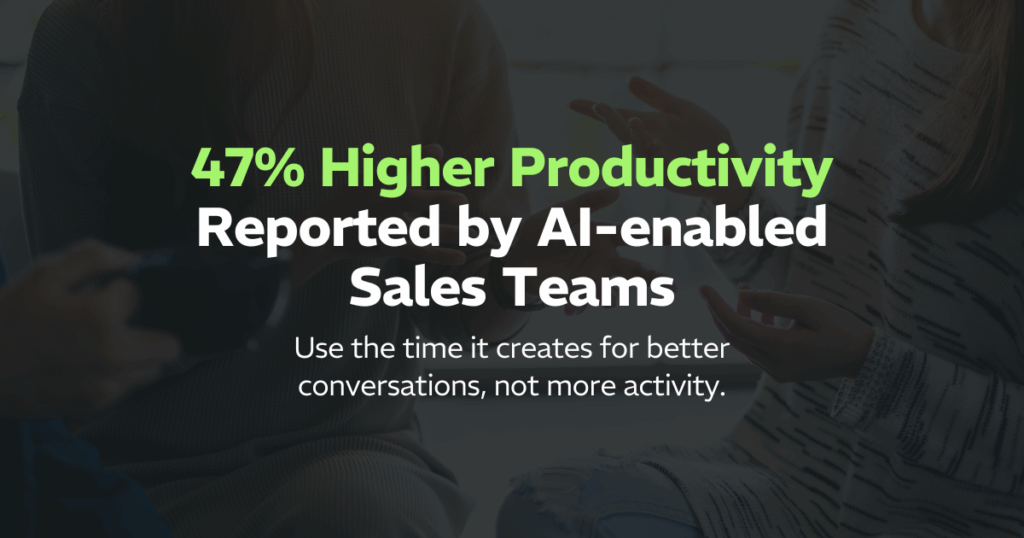
AI is changing the economics of selling by freeing up capacity. Reps can offload basic research, note-taking, data entry, and basic follow-up to intelligent agents and workflows, reclaiming hours each week for actual selling. ZoomInfo’s State of AI in Sales and Marketing report, for example, found AI users reporting roughly 47% higher productivity and about 12 hours a week saved.
For leaders, the question becomes: How do we reinvest that time? Human-centered growth means using the extra capacity for better preparation, deeper discovery, and more thoughtful account planning. not just more activity.
Personalization That Powers Land-and-Expand
Growth strategies built around retention and expansion benefit directly from AI-driven personalization. Generative and predictive tools can tailor outreach to decision makers, renewal plays, and cross-sell or upsell recommendations at scale, based on how customers are actually using your product and where they are in their journey.
That kind of relevance makes it easier for your team to show up as a partner, not a vendor. It supports NRR-led, land-and-expand motions by helping sellers connect the next product, module, or service to a very specific outcome the customer cares about.
More Confident Forecasts and Portfolio Bets
AI-driven sales forecasting and scenario modeling are giving leaders a more honest view of the business. You can use pattern recognition across cycle times, win rates, and deal risk to see where the strategy is working and where it isn’t.
That supports smarter portfolio decisions: which segments to lean into, which regions to fund, which products or SKUs deserve more coverage, and where to adjust quotas or headcount. EY research highlights how AI-enabled forecasting and planning are becoming core to how leading companies make growth decisions.
Always-On Coaching and Development
AI is also reshaping how we develop sales people. Conversation intelligence and coaching tools can surface where deals stall, which questions land, and where specific reps might need support.
That enables a different kind of training: more frequent, specific, and embedded in the work. Regular refreshers on sales training techniques keep capabilities sharp, and AI makes that easier than ever.
The Shift to AI-Native Go-to-Market
Finally, AI is starting to change the structure of sales organizations themselves, not just their tools. Early evidence from GTM benchmark reports suggests a divide between AI-forward teams and everyone else: AI-native organizations are running leaner teams, using agents to handle more of the research and administrative work, and focusing human sellers on high-complexity, high-value opportunities.
That doesn’t diminish the role of the salesperson. It raises the bar. In an AI-native GTM model, your competitive advantage is how your people show up—with insight, clarity, and genuine connection—once the data and automation have done their job.
AI will keep transforming how we design and execute sales growth strategies. The differentiator won’t be who has the most tools. It will be who uses those tools to create more time, more space, and more support for the human work at the center of every great sale.
How to Select the Right Sales Growth Strategy for Your Organization
Choosing the right sales growth strategy isn’t about copying what another company did or chasing the latest trend. The right strategy has to fit your business.
Clarify Long-Term Organizational Goals
A sales growth strategy is not chosen in a vacuum; it has to support the company’s broader business strategy and long‑term priorities. Start by clarifying what “winning” should look like over the next 2–3 years: the kind of company you are trying to build, the customers and markets you want to prioritize, and the non‑negotiable financial guardrails such as profitability and acceptable payback on investments. Once those goals are explicit, you can narrow the field to a few on‑strategy growth paths and then decide which sales growth approaches are worth testing.
Understand How You Grow Today
Next, take a clear look at where growth is actually coming from now. Separate new logos from expansion, and examine performance by segment, industry, region, and product line. Patterns in win rates, deal size, and retention will show where the business already creates outsized impact for customers—and where it struggles. Those realities form the baseline for any credible sales growth strategy.
Play to Your Strengths
The right strategy is the one that builds on your unfair advantage—the places where your assets, capabilities, and customer relationships already give you an edge. The goal isn’t to chase every path that could work in theory, but to select the few growth strategies that are most naturally supported by your economics, your talent, and the trust you’ve already earned in the market.
Choose a Primary Growth Engine
From that shorter list, identify one primary engine of growth and, at most, one or two supporting plays. Explicitly naming a primary strategy—rather than treating all options as equal—creates focus for sales, marketing, and customer success. Just as important is deciding what will be de-emphasized in the near term so people aren’t pulled in competing directions. Clarity about the main bet is what turns strategy from a concept into a real guide for action.
Test, Learn and Commit
Finally, pressure-test the chosen strategy in the field before you lock it in as the primary path. Pilot in a region, segment, or vertical with clear expectations and a small set of metrics that reflect the long-term goals. Use performance data and feedback from customers and the front lines to refine the motion, then commit and scale. Over time, the sales growth strategy can evolve through learning, but the underlying discipline stays the same: align to the organization’s goals, build on where you already create meaningful value, and keep the focus narrow enough that people can execute with confidence.
Is Your Sales Strategy Built for Growth?
Sales strategies that are truly built for growth do more than chase this quarter’s number. They connect the team to a clear purpose, make deliberate choices about where and how to win, and create the conditions for people to deliver real value in every customer conversation.
Ready to activate your next stage of growth? Learn how to build a high-performing, impact-driven sales culture with the Sell for Impact sales keynote.