Sales skills have changed, and the best reps aren’t the loudest in the room.
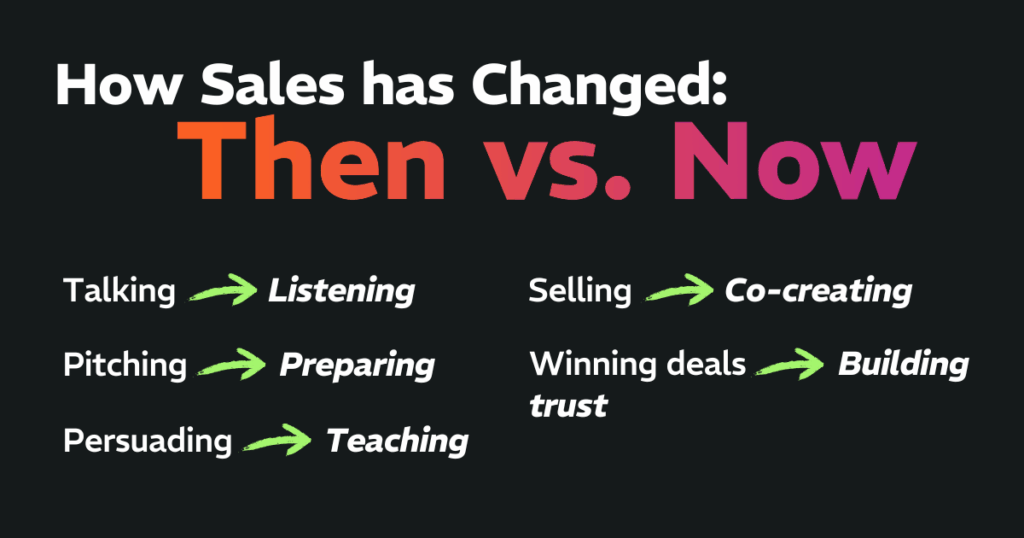
They’re listening more than they’re talking. They’re preparing more time than they’re pitching. And they’re making every customer feel seen, understood, and valued.
The job of a sales professional has gotten harder — no question. Buyers are more informed. Decision cycles stretch longer. More people sit at every table. But top performers aren’t complaining. They’re adapting.
What’s their edge? The right selling skills, sharpened relentlessly.
Here’s what actually separates the best from the rest.
What Are the Most Essential Skills for Sales Today?
Sales skills are the capabilities that help a professional understand customer needs, build trust, communicate value, and guide high-stakes decisions.
In practice, that shows up in the way we prepare before sales conversations, the quality of questions we ask, how attentively we listen, and how we adapt and solve problems in real time. Sales isn’t a personality contest; it’s a skilled profession. The best reps respect the craft, treat practice as part of the job, and combine technical selling with emotional and situational intelligence so every interaction creates value.
Modern selling rewards this blend of mastery and mindset. Preparation earns permission to go deeper. Clear, concise communication turns complex ideas into actionable paths forward. Empathy opens the door to co-creating solutions buyers can actually adopt. None of this is innate. It’s learnable, coachable, and improvable with deliberate practice and feedback.
Why Strong Sales Skills Matter More Than Ever
The buying environment has shifted, and with it the skill set that separates top performers. Three big shifts have fundamentally altered the landscape and made this job more demanding than ever.
- We’re meeting customers much later in the decision cycle. Buyers prefer self-service research. By the time they talk to a sales rep, they’re already 60-70% through their decision process. We have to add value immediately with insight they couldn’t find on their own.
- More people are involved in every decision. The CFO cares about cost. The CRO cares about revenue impact. The CHRO cares about adoption and culture fit. Successful selling requires navigating multiple agendas simultaneously.
- Decision cycles are taking longer. Economic uncertainty, budget scrutiny, risk aversion—all of it adds up to buyers delaying decisions. Creating urgency and demonstrating differentiated value has never been more critical.
Core Sales Skills Examples That Set Top Performers Apart
If you’re looking to learn how to improve sales team performance, you can never go wrong with revisiting the fundamentals.
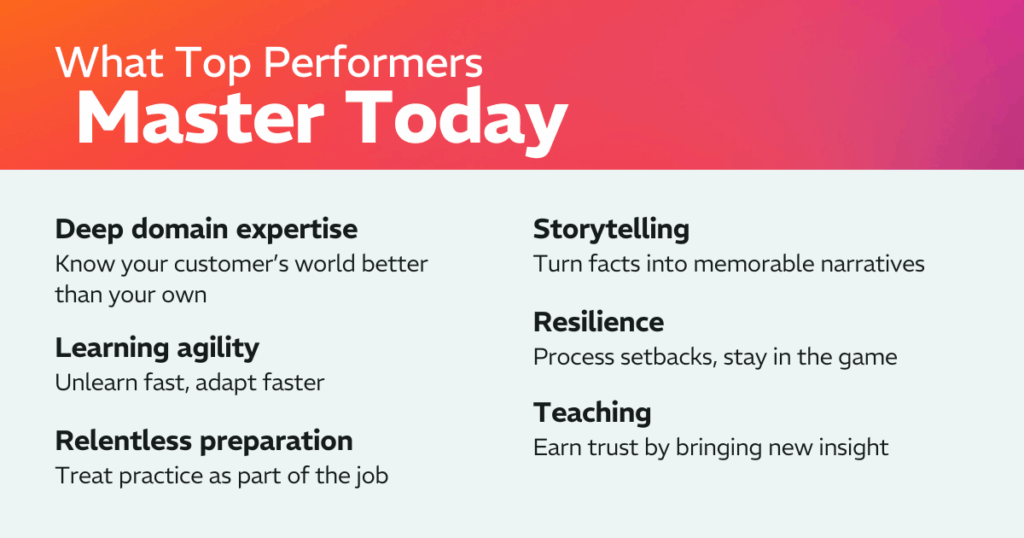
Domain Expertise
Product knowledge is table stakes. What matters more is understanding your customer’s industry, their competitive landscape, their strategic challenges, and how your solution fits into their bigger picture.
Top performers study their customers’ worlds. They read industry reports. They follow trends. They understand the regulatory environment, the technology shifts, the talent challenges their customers face.
A lack of preparation from their vendor partners in meetings is one of the biggest frustrations of buyers. Never get on a sales call without researching the customer’s landscape and what challenges they’re likely facing.
Adaptability
What worked in 2019 doesn’t work today. Buyer behavior has fundamentally changed. Technology is accelerating everything. Learning agility in sales isn’t optional anymore.
Top performers don’t resist change. They lean into it. They’re constantly asking:
- What do I need to unlearn?
- What new capabilities do I need to develop?
- Where are the gaps in my approach?
- Why Learning Agility is a Critical Skill for Sales Teams Today
Preparation
The best sellers treat their craft like athletes treat their sport. They practice. They study film. They get coaching.
Athletes also spend about 98% of their time practicing and preparing for the 2% of time they’re actually in competition.
I’m not suggesting a 98/2 ratio for sales professionals. But if you’re not practicing, role-playing, or studying your own performance, then you’re practicing on your customers.
Storytelling
Facts inform; stories persuade. Translate features into outcomes with before/after narratives and customer proof as part of every sales pitch. Build a short library of impact stories by persona so a CFO, CRO, and operator can each see the same solution through their own lens. Memorable stories travel inside the customer’s organization without you in the room.
Resilience
Sales is hard. We hear “no” more than “yes.” Deals fall through at the last minute. Budgets get frozen. Priorities shift.
Resilience doesn’t mean pretending it doesn’t hurt. Of course it does. The goal is to learn how to process setbacks quickly and stay in the game.
After you lose a deal, there’s gold in that feedback. Ask: “We were close, but you went with someone else. Can you help me understand what was different about their approach?” That vulnerability builds respect, and sometimes it even reopens the door.
Teaching
The person who can ask the right question at the right time wins. But the next level is helping a customer see their situation differently by teaching them something valuable. This is the foundation of effective sales.
This is about bringing an outside perspective of value. Pattern recognition across other customers. Saying, “Here’s what I’m seeing in your industry that you might not be aware of yet.”
When you earn the right to challenge a customer to think differently about their future in partnership with you, that’s when you become a trusted advisor, not just another salesperson.
Technical & Operational Sales Skills That Scale Growth
These operational sales skills help reps turn insight into momentum by spotting risk earlier, reducing late-stage friction, and making the business case land with every stakeholder.
Data Literacy
Conversion rates by stage, average cycle time by segment, and activity-to-outcome ratios help sales reps qualify better and managers coach earlier. Data literacy directs time toward high-probability deals, surfaces risk before quarter-end, and improves planning across territories.
Navigating Procurement
Late-stage friction kills good deals. Map the customer’s procurement steps early, align on required documents, and pre-negotiate standard redlines where possible. Clear checklists, owner assignments, and target dates compress cycle time and prevent last-mile surprises.
AI-Assisted Selling
AI should speed up the work that should be fast (research, call prep, messaging, and follow-ups) so reps can focus on the work that must be great. Use it to summarize accounts, tailor outreach, generate call plans, and surface next-step options from conversation notes. Keep human judgment in the loop: verify facts, align to brand voice, and personalize for the stakeholder.
ROI Modeling
CFO scrutiny is the norm. Build a simple, defensible business case with assumptions, expected impact, time-to-value, and proof. Tie outcomes to the metrics that matter and show sensitivity (best/base/worst). Quantified value turns interest into internal advocacy and gives champions a tool to advance the deal.
Sales Communication Skills That Strengthen Relationships
People buy from people who make them feel understood. All the product knowledge and preparation in the world won’t help if you can’t build genuine human connection. These sales soft skills often make the difference between a closed deal and a missed opportunity.
Professional Listening
Professional listening goes deeper than just being quiet. It’s about what I call “looping to understand.” Here’s how it works:
- Ask an effective open-ended question.
- Listen attentively. And really listen. Don’t just wait for your turn to talk.
- Probe with followups twice for clarity. “Tell me more about that.”
- Summarize for confirmation. “So what I’m hearing is…”
This simple framework for effective communication increases trust and likability in sales exchanges by 40%. Why? Because it makes customers feel seen, understood and valued.
Negotiation That Preserves Trust
Negotiation starts early and continues throughout the cycle. Anchor on outcomes, expand the pie with creative variables (terms, scope, resources), and trade rather than concede.
Stakeholder Management & Multi-Threading
Most B2B buying decisions are made by committees. Map the landscape, understand priorities and concerns by role, and build parallel paths to influence. Multi-threading de-risks single-point failure, aligns messages to each lens, and keeps the deal advancing even when one sponsor’s bandwidth drops.
Authentic Curiosity
Buyers can tell when you’re asking questions just to advance your agenda versus when you’re genuinely curious about their world.
Deep curiosity over control separates elite performers from average sellers. Rather than pushing a predetermined agenda, become fascinated by your prospects’ situations. Ask layered “why” questions. Dig into root causes, not just surface-level pain points.
When you approach conversations with genuine curiosity, customers tell you what they need. They guide you toward what they want to buy. Listen to your customers, and they’ll show you the right direction.
Social Selling & Personal Brand
Buyers form opinions before the first meeting. A credible digital presence warms outreach and influences early research. Share POV content, engage with target accounts, and use social listening to spot timing and trigger events. Done well, digital selling opens doors your emails can’t and equips champions with material they can circulate.
Digital Meeting Facilitation & Async Communication
Building relationships through virtual selling requires an agenda with outcomes, visuals that carry the story, time checks to keep pace, and a concise recap with decisions, owners, and dates. Between meetings, asynchronous updates (short Looms, one-page briefs, annotated decks) sustain momentum and make it easy for stakeholders who missed the live call to get current.
Emotional Intelligence
Emotional intelligence amplifies every other capability on this list by enabling you to:
- Handle rejection and pressure without becoming defensive.
- Read the room and adapt based on what you’re sensing.
- Build rapport quickly with different personality types.
- Stay composed during objections instead of getting rattled.
When you’re emotionally regulated, you can challenge prospects constructively and provide honest guidance without desperately chasing validation. And if your goal is to move into management, EQ becomes an even more critical sales leadership skill.
Strategic Sales Skills That Drive Co-Creation
This is where you move from order-taker to trusted adviser.
Business Acumen
It’s not enough to understand your solution anymore. You need a detailed understanding of your buyer’s world, their future, their challenges, their needs.
Ask yourself:
- What are the top three priorities for this customer’s CEO right now?
- How does my solution connect to revenue growth, cost reduction, or risk mitigation?
- What metrics will they use to measure success?
- Who are the internal champions, skeptics, and influencers?
When you speak the language of business outcomes, you earn a seat at the table with senior executives. Developing these sales leadership skills changes everything about how you engage with customers and achieve sales success.
Insight-Led Consulting
You have to earn trust and advocacy by demonstrating expertise, critical understanding, and insight into the customer’s universe.
This is about being proactive, not reactive. Becoming a true sales leader requires surfacing problems your customer might not fully see yet. It’s about challenging them — respectfully — to think differently about their future.
The way to introduce solutions is based on the customer’s perspective—using sales strategies that position you as a partner:
- “Because you said…” (their insight, their rationale, their priorities)
- “I would recommend…” (your customized solution specific to their situation)
This positions you as a partner, not a vendor. You’re co-creating solutions together.
Closing the Sales Skills Gap Through Better Sales Training
Even high-performing teams outgrow yesterday’s strengths. To close that gap, you must acknowledge it, normalize it, and commit to closing it with the same discipline you bring to pipeline and performance.
Ready to level up your team’s sales skills? Learn how our sales keynote Sell for Impact can equip your team for what’s next.