Which of your people, if they told you they were leaving for a similar job at a competitor, would you fight hard to keep?
I mean the person whose presence makes the work better — who challenges your thinking, creates clarity where others add noise, and has shaped the business in ways no job description could have anticipated.
Netflix calls it the Keeper Test, and those people are rare. They always have been. And they always have options.
The gap between what exceptional people produce and what everyone else produces has never been wider. McKinsey research shows that in complex roles — sales, management, knowledge work — top performers are 800% more productive than average performers. Not 20% more. 8x more.
And the leaders who treat a soft hiring market as permission to relax on attracting and retaining high performers are making a very expensive mistake when it comes to the people who matter most. Turnover at the top is not just a people problem — it's a bottom line problem. The cost compounds every quarter.
Top talent — exceptional performers — is always in short supply. Always. The world's best people don't sit still waiting for the market to recover. They move toward opportunity, toward growth, toward leaders who share their ambition.
The leaders who keep exceptional people understand that a deliberate retention strategy is a competitive advantage — and it's available to any leader willing to build for it.
The AI Era Makes This More Urgent, Not Less
A lot of leaders are telling themselves a dangerous story right now: AI is closing the gap between top performers and everyone else, so the stakes around talent are lower than they used to be. It's a reasonable story. It's also wrong.
Yes, AI boosts lower performers on routine, bounded tasks — writing drafts, processing information, handling structured workflows. That's documented and real. But that is not where strategic value gets created. In complex, judgment-intensive work — the kind your best people are actually doing — the research tells a different story entirely.
A Northeastern University study across 52,000 decision-makers found that access to AI feedback widened the skill gap over time, not narrowed it. High performers sought feedback after failures and learned from it. Lower performers sought validation after successes. Same tool. Opposite trajectories.
Deloitte's research found that high-performing teams get twice the quality from AI as average teams. The technology doesn't create exceptional performance — it amplifies the human capability already there. Long term, the organizations that invest in employee engagement and the conditions that make exceptional people want to stay will compound that advantage. The ones that don't will watch the gap widen from the wrong side of it.
Artificial intelligence does a great job scaling volume. But it's authentic intelligence — your judgment, your experience, your knowledge of the customer's world — that scales value. And that lives in people. The exceptional ones.
The leaders who understand this aren't relaxing their standards. They're raising them. And they're building the conditions that make their best people want to stay.
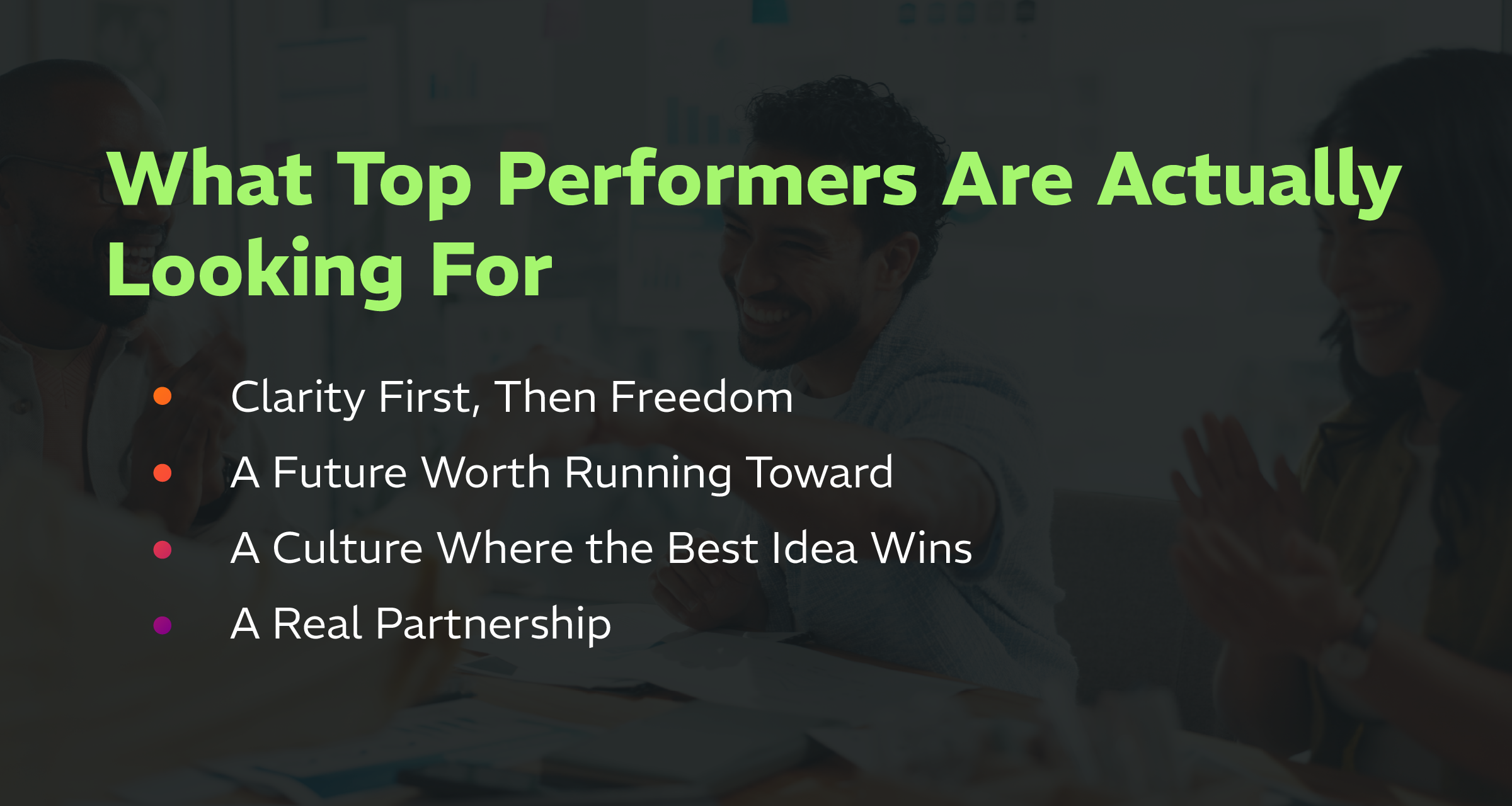
What Top Performers Are Actually Looking For
I've spent a lot of time in rooms with exceptional people — and I've watched a lot of them leave organizations that should have kept them. When employees leave, it's rarely about one thing. The pattern is almost never about compensation alone. It's about the work environment and company culture they're being asked to operate in — whether they feel like the place is built for people who want to win.
Here's what that looks like in practice.
Clarity First, Then Freedom
We define expectations precisely, make winning obvious, and then get out of the way. The best performers don't want to be managed into results — they want to be trusted to find their own path to them. Ambiguity doesn't humble them; it frustrates them. They know what they can produce. They want a target worth running at — and a work-life balance that lets them sustain the pace and actually perform at their best.
A Future Worth Running Toward
Exceptional people want to win, and progress builds confidence. The more clearly we paint where we're going — and make it compelling enough to build toward together — the more they lean in. They're not just choosing a job. They're choosing a chapter. Make the next chapter worth choosing.
A Culture Where the Best Idea Wins
I'm wrong all the time. When we create an environment where people feel safe to challenge, contribute, and lead regardless of title, the best thinking rises. That's how we win in the market. Exceptional performers don't want hierarchy — they want merit. If the person with the best idea in the room isn't the one being heard, you'll lose them to someone who will listen.
A Real Partnership
The exceptional people on our teams aren't just executing job descriptions. They're shaping the business. They want meaningful work — the sense that what they do here matters and that they belong to something worth building. The more we treat them that way — with real ownership, real input, real stakes — the harder it becomes for them to imagine being anywhere else.
How to Retain Top Talent
Understanding what top performers want and actually building for it are two different things.
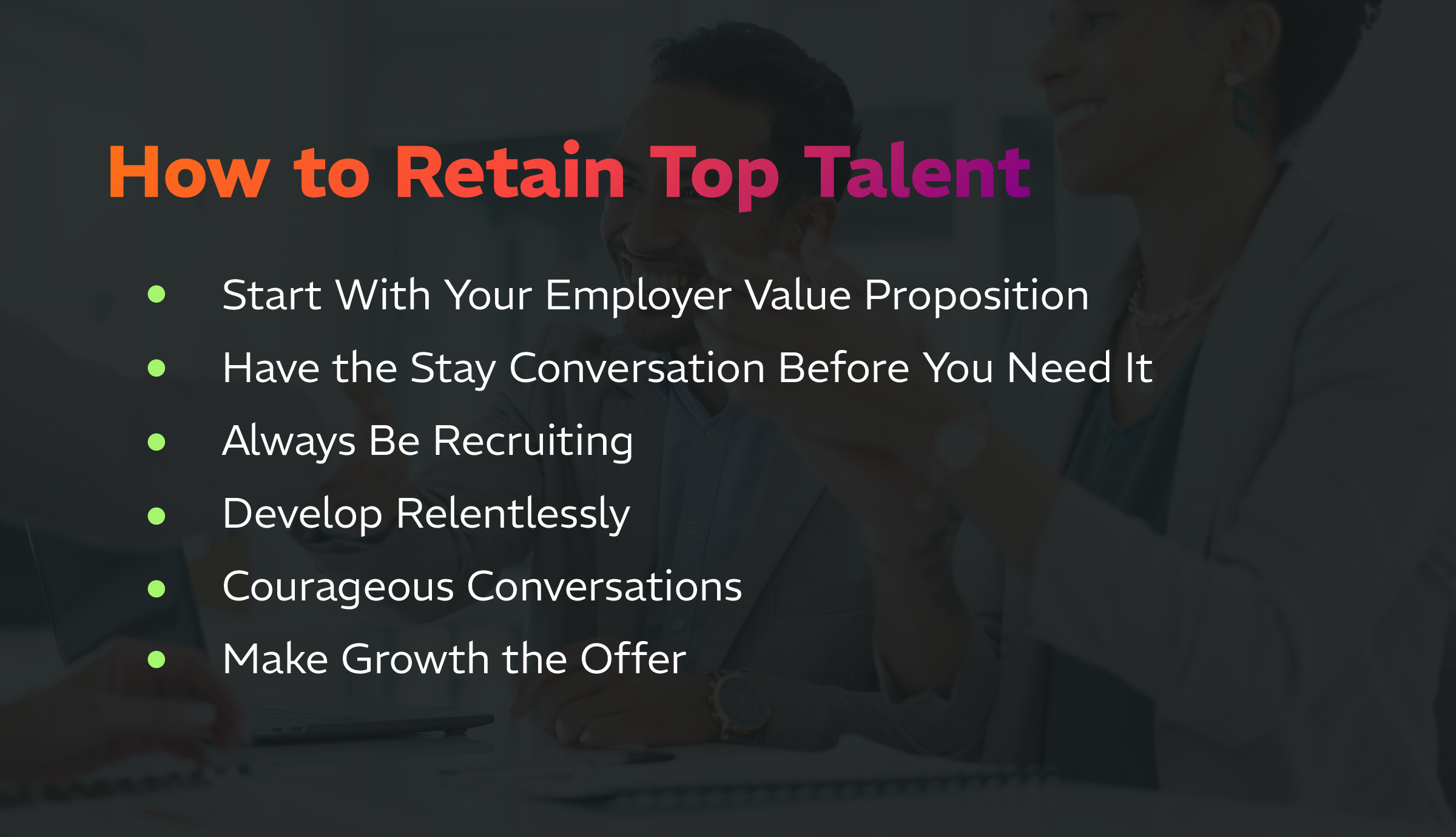
Start With Your Employer Value Proposition
The best organizations I've studied are deliberate about the promise they make to exceptional people. Mayo Clinic calls theirs "a life changing career" — and they mean it literally. Not just a job that saves lives, but a place that transforms the employee experience of everyone who works there.
That promise is front and center in every recruiting conversation and every retention decision. What's your version of that promise? If you can't articulate it, your best people will find someone who can.
Have the Stay Conversation Before You Need It
Most leaders wait until someone is already out the door to ask what would make them stay — or worse, find out in exit interviews what they could have fixed six months earlier. By then, something has broken down. Retaining employees starts long before there's a resignation on the table. I make a practice of checking in with my key people throughout the year — not in formal reviews, but in real conversations. What are you working on that excites you? What's getting in your way? Where do you want to go? When you ask those questions before there's a problem, you can actually do something about the answers.
Always Be Recruiting
Top talent doesn't wait for an open requisition. I pipeline talent constantly — it's part of my weekly rhythm. When a role opens, I want options already in motion, not a blank page. And I want a reputation as the kind of leader people want to work for, long before they need a job. If your competitors have someone exceptional, you should know who they are. That's how you build a team that consistently operates above the market.
Develop Relentlessly
The best sales organizations train every day. The best performers on any team are investing in their own career growth — and they expect their leaders to invest in it too. Professional development isn't a perk. It's the agreement we make with exceptional people when they choose to give us their best. If I'm going to ask a lot of my people, I have a responsibility to make them better. Coaching, feedback, real growth opportunities — that's how you earn the right to keep asking.
Courageous Conversations
Top performers thrive in environments where expectations are clear and nothing festers. What drives them out is leaders who avoid the direct conversations that high performance requires. That means the courage to tell someone they're falling short before it becomes a pattern. The courage to ask a star player what they actually need before they've already decided to leave. Leaders who build that kind of honest environment don't just retain their best people — they give them a reason to raise their own standard. Courageous conversations aren't the hard part of the job. Avoiding them is.
Make Growth the Offer
I tell the young talent in my orbit the same thing: hire your boss. Make sure the person you're going to work for is going to pour into you, develop you, and spend real time with you. That's a career accelerant — or a significant setback — and it matters far more than the company name. When I bring exceptional people into my organization, I make them a version of that promise: you give me everything you have, compete and contribute, and I will be an ambassador for you for the rest of your life. That's an offer that's hard to walk away from.
The Leaders Who Keep Exceptional People
The leaders who consistently retain top talent don't treat retention as a program. It's not an initiative you launch when someone resigns. It's the natural result of leading well — building clarity, investing in growth, and creating a culture where the best ideas win and people feel like genuine partners in what's being built.
Those organizations don't just keep their best people. They attract more of them. Exceptional people talk. They refer their best colleagues to leaders they trust and organizations where they've seen what good looks like.
That compounding effect — on performance, on culture, on your ability to compete — is the real return on human-centered leadership.
Build the Culture That Retains Exceptional People
The leaders who retain top talent aren't running better programs. They're building better environments — where expectations are clear, growth is the offer, and people feel like partners in something worth building.
That's the work of human-centered leadership. My Human-Centered Leadership keynote is built around exactly this — helping organizations shift from managing outcomes to unlocking the contribution, ownership, and sustained high performance that exceptional people are capable of when the conditions are right.