You’ve launched a new go-to-market motion, rewritten the sales comp plan, and layered in cutting-edge tech to accelerate it — yet 6 months later, reps are still selling the old way and the forecast hasn’t moved.
That gap between a well-designed strategy and what actually happens in the field isn’t just a sales execution issue; it’s a change leadership issue. Enterprise sales leaders today are driving constant shifts in GTM, territories, pricing and process inside organizations where the team is already at full capacity and tolerance for “another initiative” is low.
The sales leaders who consistently navigate this pace of change are the ones who’ve built strong change management skills.
What Are Change Management Skills?
Change management skills are the capabilities required to lead, support, and embed change in people, processes, and culture.
These aren’t the same as project management skills, though you need those too. A project manager focuses on timelines, budgets, and deliverables. Change management for leaders is about hearts, minds and behaviors.
Traditional change management focused on systems and processes. The modern approach, what I call change leadership, recognizes that transformation happens one person at a time.
The difference between the old way and the new one is profound. One treats people as obstacles to overcome. The other treats people as the entire point.
Why Change Management Skills Matter More Than Ever
The environment your sales organization operates in is more volatile than it’s ever been. Buying committees are larger. Customers are more risk-averse. Sales cycles are longer and scrutinized at every stage. AI is reshaping both how you prospect and how your customers evaluate you.
In that context, you’re not leading a steady-state sales machine. You’re leading a system that’s always in motion: New motions, new metrics, new markets.
Most of us didn’t get trained for this. We learned how to build plans, run QBRs, manage the funnel, and hit the number. We didn’t learn how to guide people through letting go of the old playbook, operating in uncertainty, and rebuilding confidence on the other side of disruption.
When those change management skills are absent at the top of the revenue organization, the impact is immediate and expensive. Turnover ticks up, often with your best people leaving first. Engagement erodes as managers and reps wait out “the flavor of the quarter.” Execution slows as the field splits into early adopters, skeptics, and quiet resisters. You see more sandbagging, more shadow processes, more “we’ll really do it this way” conversations in the hallway.
On the other hand, when change management is treated as a core leadership capability, the culture shifts. Managers tell the truth about what’s working and what isn’t. Reps get involved in shaping how strategy comes to life in deals. Cross-functional partners start to feel like part of a single GTM engine, not a set of competing agendas.
That’s the difference between change as a tax on the business and change as a competitive advantage.
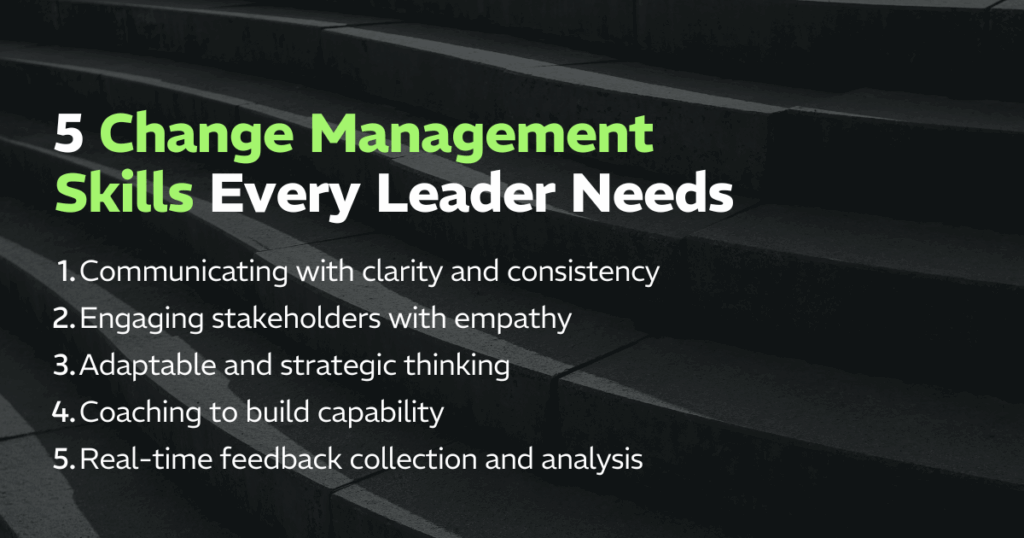
5 Core Change Management Skills for Senior Sales Leaders
These are the leadership skills that everyone needs to develop to manage change effectively.
Communication With Clarity, Consistency, and Connection
If you can only focus on developing one skill, this would be it. Communication is the foundation of everything else in change management.
Real communication in times of change is about clarity, consistency, and connection.
- Clarity means explaining why the change is happening in a way that makes sense to your team. Not the corporate reason, the human one. Why does this matter to them? Why now? Why should they care?
- Consistency means saying the same message, in the same way, over and over again. People don’t absorb information the first time they hear it, especially when they’re anxious. The ability to effectively communicate the same core message across different formats and audiences is what separates leaders who drive change from those who create confusion. Repeat yourself. Then repeat yourself again. And mean it — say the same thing to your team that you say to leaders.
- Connection is built by listening as much as you talk. Create space for questions, concerns, and pushback. Active listening — giving people your full attention and really hearing what they’re saying — builds trust. When people feel heard, resistance softens.
Try this: Next time you need to announce a change, ask yourself: “If I only had 60 seconds to explain why this change matters to my team, what would I say?” Write it down. Practice it. Then use it everywhere: emails, meetings, and hallway conversations.
Empathy & Stakeholder Engagement
Change doesn’t just impact one team. It ripples through people like your leadership team, your direct reports, cross-functional partners, customers, and sometimes even board members or investors.
Your job as a change leader is to understand what each stakeholder cares about and engage them early and often. Managing transitions effectively means recognizing that different people move through change at different speeds, and meeting them where they are. This is where empathy becomes your superpower.
When you lead with empathy, you don’t eliminate resistance, but you can repurpose it. Resistance stops being an obstacle and becomes valuable feedback about what’s not working. In fact, learning to turn fear into focus is one of the most powerful shifts a change leader can make.
Try this: Map your key stakeholders. For each one, write down: “What’s in it for them?” and “What’s their biggest concern?” Then design your engagement strategy around those insights.
Adaptability & Strategic Thinking
Change never goes according to plan. Ever. You’ll hit roadblocks. You’ll discover things you didn’t anticipate. People will respond in ways you didn’t expect.
The leaders who succeed are the ones who can pivot when reality hits while staying committed to the desired long-term outcome. This is what leading through uncertainty looks like in practice.
Adaptability is about staying flexible in your approach. Strategic thinking is about seeing the big picture and connecting the dots between the change initiative and broader business goals. These are the skills that separate good leaders from great ones.
One of the biggest mistakes I see leaders make is treating change as a one-time event.
They announce the change, hold a kickoff meeting, and assume people will figure it out from there. But successful change management recognizes that change isn’t an event. It’s a management process, and it’s one that requires you to anticipate obstacles, adjust course, and ensure that every action supports the change you’re trying to drive.
Try this: Create a simple one-page change roadmap. At the top, write your desired outcome. Then work backwards: What needs to be true six months from now? Three months? This month? This week? Share it with your team and revisit it weekly.
Coaching and Capability Building
Here’s a hard truth: your team doesn’t need you to have all the answers. They need you to help them find their own.
The best change leaders are great coaches. They ask questions instead of giving directives. They create space for people to experiment, learn, and grow. They recognize that sustainable change requires building new capabilities, not just implementing new processes.
Coaching is about being intentional. It’s about shifting from “I’ll tell you what to do” to “I’ll help you figure it out.” It’s also about problem solving together by creating an environment where your team feels safe surfacing challenges and working through solutions collaboratively.
When you coach your team through one change, you’re building their capacity to handle the next one. And the one after that.
Try this: The next time someone comes to you with a challenge, resist the urge to solve it for them. Instead, ask: “What do you think we should do?” Then follow up with: “What would need to be true for that to work?” These two questions shift the dynamic from dependency to ownership.
Real-Time Feedback Collection and Analysis
You can’t improve what you don’t measure. But in times of change, leaders often narrowly focus on a handful of metrics.
They track lagging indicators like revenue, retention, or productivity. Those matter, of course. But they don’t tell you how the change is going. They tell you whether it worked well after the fact.
Great change leaders track leading indicators: adoption rates, engagement levels, skill development, and trust. In some cases, you might also track key performance indicators (KPIs) like time-to-competency on new systems or the number of employees actively using new tools. These give you early signals about what’s working and what needs to be adjusted before it’s too late.
But numbers alone aren’t enough.
Real continuous improvement requires both data and dialogue. Create feedback loops. Check in regularly with your team. Listen to employees — not just what they say in formal surveys, but what they’re telling you in team meetings or casual conversations. Ask what’s working, what’s not, and what they need from you. Then actually do something with that feedback.
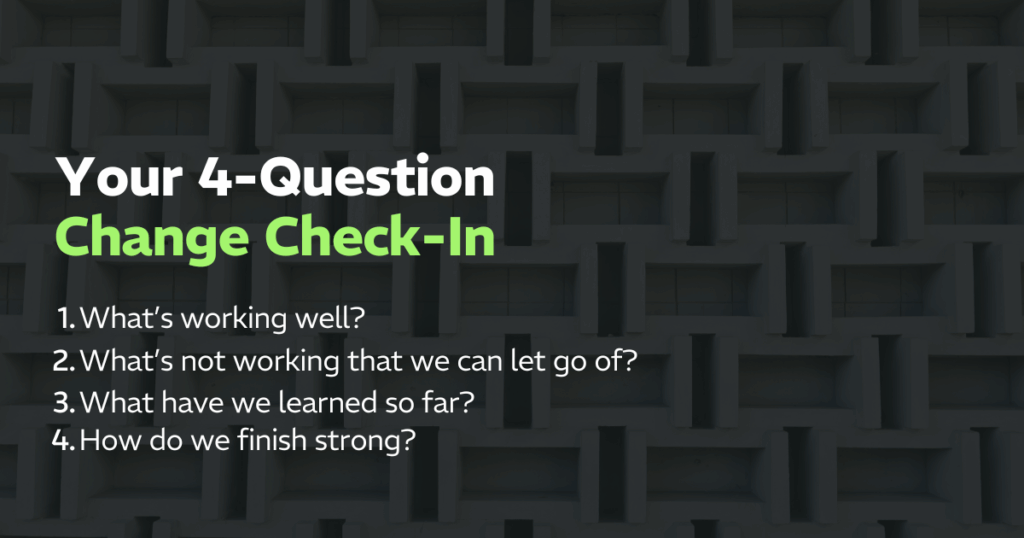
Try this: At the midpoint of any change initiative, pause and ask your team these four questions:
- What’s working well?
- What’s not working that we can let go of?
- What’s something new we’ve learned?
- How are we going to finish strong?
These questions create space for reflection and course correction.
You don’t need to master all five of these skills overnight. But you do need to know which ones you’re strong in—and which ones need work. Start with honest self-assessment. Then commit to growth.
How to Build Your Change Management Skills as a Leader
Knowing what skills you need is one thing. Developing them is another. Here’s the roadmap I use—and teach—for leaders who are serious about becoming better at leading change.
- Start with self-awareness. You can’t lead others through change if you haven’t done the work on yourself. On a scale of 1 to 10, where are you at maximizing your potential as a change leader? Rate yourself on each of the core skills above. Don’t overthink it. Then ask: What can I do today that I am not already doing to close that gap?
- Create your leadership vision. Most leaders have a vision for their business. Few have a vision for themselves as leaders. Ask yourself: When this change is over, how do I want my team to describe the way I led them through it? That’s your North Star. Write it down and read it every week.
- Build a feedback mechanism. Ask your direct reports this question: “Is there anything I could do differently that would help support you in accomplishing your goals?” Then listen. Don’t defend. Don’t explain. Just listen. Do this regularly and you’ll see your blind spots before they become problems.
- Practice in real-time. Pick one skill and focus on that for the next 30 days. Find opportunities to practice it every single day. These little experiments are low-stakes ways to test new behaviors and build new habits.
- Embed daily rituals. Leading change is emotionally taxing. Create space to self-reflect. My morning routine is non-negotiable: a few minutes of breathing or meditation, then journaling. Some days it’s five minutes. Some days it’s thirty. But it’s always there. Find your version of this.
- Measure your progress. Every quarter, go back to that 1-10 scale. Are you moving in the right direction? Are the gaps closing? Don’t just measure yourself—measure the impact you’re having on your team. Are they more engaged? Are they adopting the change faster? Those are the signals that matter.
Common Change Management Pitfalls
Even with the right skills, change is messy. Recognizing these potential issues is the first step to avoiding them.
- Moving too fast. You’re excited about the change. You want to see results. So you push too hard, too fast. And people shut down. The fix: Build momentum gradually. Celebrate small wins along the way.
- Underestimating resistance. Resistance isn’t a sign that people are difficult. It’s a sign that they’re human. The fix: expect resistance. Plan for it. Treat it as valuable feedback, not an obstacle.
- Going it alone. You think you need to have all the answers. You don’t. The fix: build your support system early. Find your accountability partners, your coaches, your trusted advisors.
- Forgetting to lead yourself first. You can’t pour from an empty cup. The fix: prioritize your own health, your own routines, your own inner work. You’re no good to your team if you’re burned out.
You Can Become a Better Change Leader
Change management isn’t about having all the answers. It’s about asking the right questions, doing the inner work, and showing up for your people with clarity, empathy, and resilience.
If you’re looking to build change readiness across your organization, I’d love to help. My change management keynote equips people with the mindset and tools to navigate transformation and empower people to thrive through change.
You’ve got this.