I spend a lot of time in rooms with senior sales leaders and revenue executives. And over the past several years, I’ve watched the conversation shift. The leaders who used to talk exclusively about pipeline and quota are now talking about B2B customer experience. About intimacy. About what it actually means to be a trusted partner versus a vendor on a procurement list.
That shift didn’t come from nowhere. It came from the market.
B2C customer experiences are reshaping B2B buying behavior. Your buyers go home at night and experience consumer-grade personalization from Amazon, Netflix, and Spotify. They say “Alexa, more paper towels” and it happens. Then they show up at work on Monday and deal with a B2B supplier who sends them a generic proposal that could have been written for any company in their industry. But somehow, they had to wait for it for a week.
Because the bar in B2B is still so low, organizations willing to operate at a higher standard from the view of the customer have an enormous competitive advantage.
What Is B2B Customer Experience?
B2B customer experience is the sum of every interaction a buyer has with your organization, from first awareness to long-term partnership. It’s not just customer service. It’s not just the product. It’s how it feels to do business with you, moment by moment, across the entire lifecycle of the relationship.
Unlike B2C, where experience is often shaped by a single transaction, B2B relationships play out over months and years across multiple stakeholders, departments, and decision cycles. That makes intentional experience design a business necessity.
Customer experience is built or eroded at every touchpoint: the responsiveness of your team, the quality of your discovery process, whether your proposal speaks to their actual challenges or recycles generic language about “driving value,” whether you show up prepared or wing it.
The B2B companies that understand this aren’t just winning more deals. They’re building relationships that are genuinely hard to displace.
Why Is B2B Customer Experience Important Today?
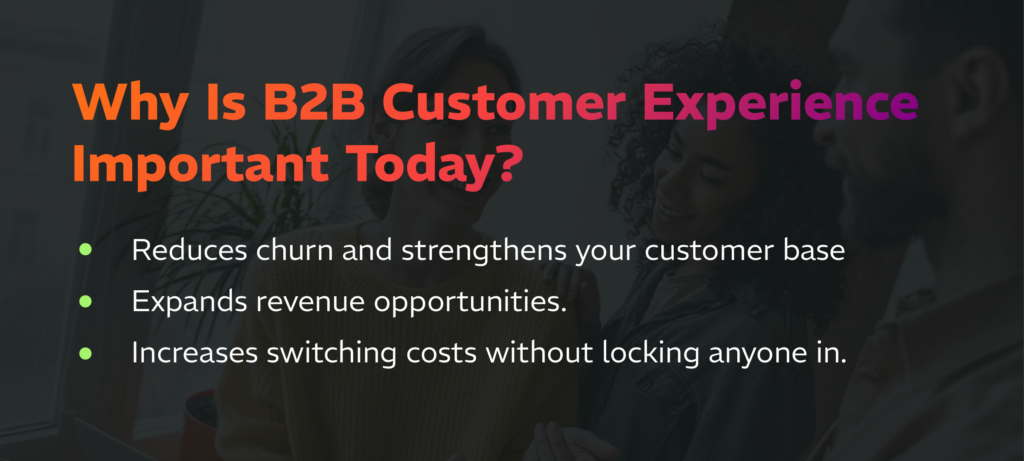
In markets where products look similar, experience becomes the differentiator. Your competitors can copy your features. They can match your pricing. They can hire your people. But they can’t replicate the trust and relationships you’ve built over time. Here's why b2b customer experience cx is so important now:
- Reduces churn and strengthens your customer base. It’s far cheaper to keep a customer than to replace one. When customers feel heard, supported, and successful, they don’t leave. Companies that excel at B2B customer experience see churn rates drop, sometimes precipitously.
- Expands revenue opportunities. Happy customers buy more. They upgrade, add users, and extend contracts. A great experience doesn’t just protect revenue; it multiplies it naturally.
- Builds advocacy. Your best customers become your best salespeople. They refer you. They write case studies. They speak at your events. That kind of trust is worth more than any ad campaign.
- Increases switching costs without locking anyone in. When the relationship is strong, the experience is seamless, and the value is clear, customers don’t leave because they can’t imagine working with anyone else.
The rules of competition have changed. For decades, B2B companies competed on product quality, pricing, and relationships. Those advantages still matter, but they’re no longer enough. Buyers are more informed, more skeptical, and more willing to switch than at any point in the history of B2B commerce and the cost of a poor experience compounds faster than most leaders realize.
How to Create Your B2B Customer Experience Strategy
The companies I’ve seen get this right don’t necessarily have fancy frameworks. They have conviction about what it means to serve their customers, and they build everything around that conviction. Here’s how to develop a strategy that actually moves the needle.
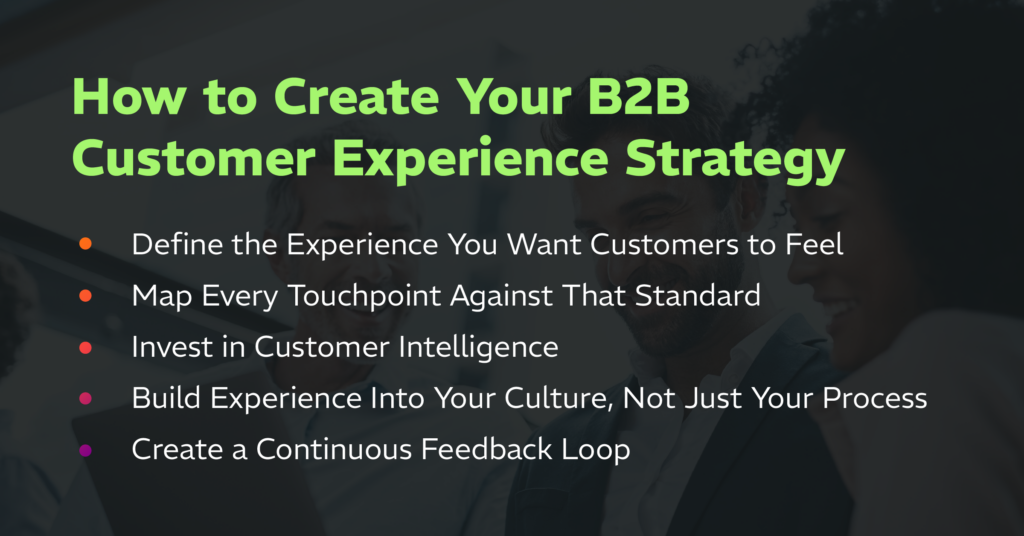
1. Define the Experience You Want Customers to Feel
Start with the emotional outcome, not the operational process. “We want customers to feel satisfied” is the floor, not the ceiling. What does extraordinary look like in your category? Starbucks made a decision years ago that they weren’t in the coffee business. They were in the human connection business. That decision changed everything downstream: how they hired, how they trained, what success looked like at the store level.
What business are you actually in? Answer that question honestly and your experience strategy starts to take shape.
2. Map Every Touchpoint Against That Standard
Every interaction your customer has with your organization is a moment of truth. Sales. Onboarding. Customer success. Billing. Support. Each one either reinforces the experience you’ve promised or erodes it. Map them all. Be honest about where you’re falling short.
The gaps you find aren’t problems. They’re opportunities to stand out.
3. Invest in Customer Intelligence
You can’t personalize what you don’t understand. The organizations that win on experience are obsessive about understanding their customers’ worlds: their goals, their pressures, the language they use to describe their problems. This means structured discovery processes, ongoing listening, and the discipline to actually apply what you learn.
Preparation is a form of respect. When your team shows up having done the work, buyers feel it immediately.
4. Build Experience Into Your Culture, Not Just Your Process
Process gets followed. Culture gets lived. The difference between a team that delivers a transactional experience and one that delivers a transformational experience often comes down to what they believe about their work. Do they see their role as executing transactions or building relationships? Do they understand that every interaction is a chance to add value, not just fulfill a task?
This is a leadership challenge as much as an operational one. And it starts at the top.
5. Create a Continuous Feedback Loop
The best B2B organizations treat customer experience as a living strategy, not a static initiative. They’re constantly gathering signals through formal surveys, informal conversations, win/loss analysis, and direct executive engagement, and using those signals to improve. They close the loop with customers. They make progress visible inside the organization. They celebrate when the experience improves and investigate seriously when it doesn’t.
The B2B Customer Experience Mistakes That Kill Relationships
Most B2B organizations aren’t losing customers in dramatic moments. They’re losing them slowly, in the accumulation of small failures that nobody flags until the renewal conversation goes wrong.
And when something does go visibly wrong — a missed deadline, a product failure, a service breakdown — how you respond is often more consequential than the problem itself.
According to Forrester research, 81% of B2B buyers end up dissatisfied with the provider they ultimately choose — not because the product failed, but because the experience did. They feel like a transaction, not a priority.
Here are the patterns I see most often.
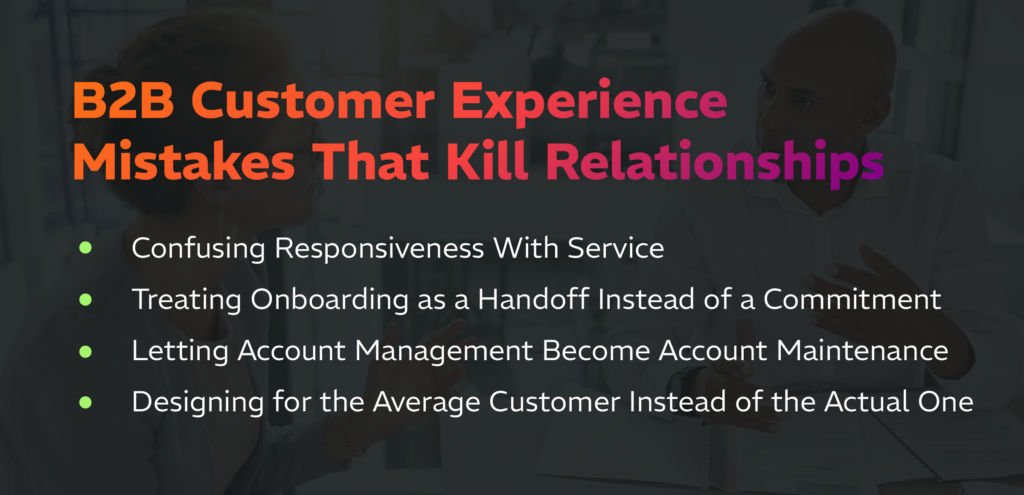
Confusing Responsiveness With Service
Being fast isn’t the same as creating value. I’ve watched sales teams pride themselves on quick follow-up while sending proposals that clearly weren’t tailored to the conversation. Speed signals availability. Preparation signals respect. Buyers know the difference.
Treating Onboarding as a Handoff Instead of a Commitment
The moment the contract is signed is where the experience either justifies itself or starts to erode. Organizations that treat onboarding as a logistics exercise — here’s your login, here’s your customer success manager, here’s the documentation — are measuring the wrong finish line. Onboarding is the first test of whether the promise made during the sale was real.
Letting Account Management Become Account Maintenance
There’s a version of customer success that looks like support but isn't. Quarterly business reviews with slides that recap what already happened. Check-in calls that don’t challenge or add. The best account relationships I’ve seen feel like a partnership where the vendor is thinking harder about the customer’s business than some of the customer’s own team members. That’s the standard worth chasing.
Designing for the Average Customer Instead of the Actual One
Segmentation frameworks are useful. They’re also a trap. The moment you start serving a "segment" instead of a specific company with specific people and specific challenges, the experience flattens. B2B personalization doesn’t scale the way B2C does — and that’s actually an advantage. You have a smaller customer base. Use that proximity to go deeper, not wider.
The pattern underneath all of these is the same: treating customer experience as something you do to a buyer rather than something you actively co-create with them. The fix isn’t a new playbook. It’s a higher standard of attention.
3 Ways to Improve Your B2B Customer Experience Starting Now
Strategy is necessary. So is execution. Here are three specific levers to improve the customer experience that tend to have the most impact.
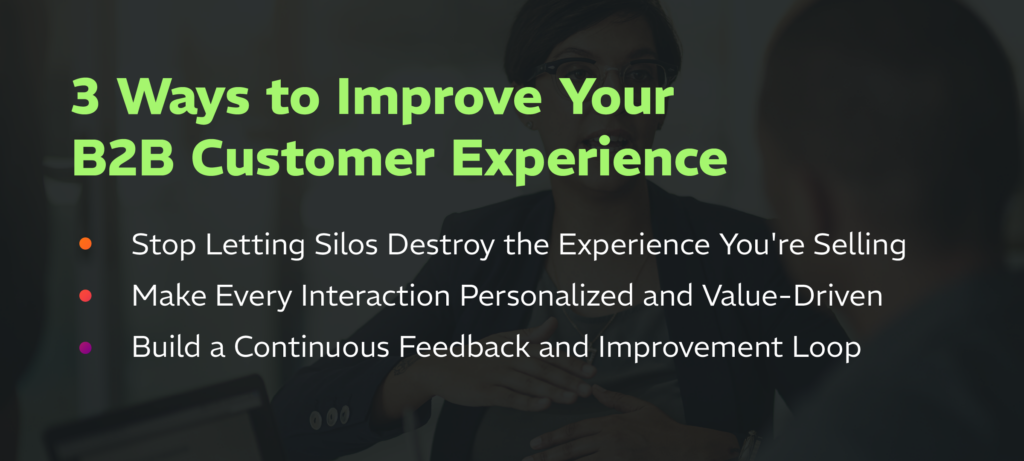
Stop Letting Silos Destroy the Experience You’re Selling
Here’s a failure mode I see constantly: a company invests real effort in building a strong sales experience — great discovery, a tailored proposal, a genuine conversation about the customer’s situation — and then the deal closes and the customer gets handed off to a team that has no idea what was said in the sales process. The account manager is starting from scratch. The onboarding team is running a generic script.
The buyer notices. They always notice. Because the experience they were sold and the experience they received are two different things.
Your buyers don’t experience your organization one team at a time. They move across sales, customer success, support, and executive relationships — often in the same day. The quality of that experience isn’t just about each interaction in isolation. It’s about whether those interactions add up to something coherent. Whether the people on your side of the table are working as a unified team or as separate departments with separate agendas.
The organizations that invest in making their customer-facing teams genuinely connected through shared context, shared standards, and shared accountability for the relationship create a dramatically better experience. And they have dramatically better retention numbers to show for it.
Make Every Interaction Personalized and Value-Driven
This is where most B2B organizations have the most room to improve. Delivering a personalized experience means more than using someone’s name in an email. It’s demonstrating at every stage of the relationship that you understand their specific situation and have thought specifically about how to help.
The best salespeople and customer success professionals come prepared to teach. They bring insights the customer didn’t have before the conversation. They ask questions that make the customer think differently about their own challenges. They don’t just respond to stated needs; they surface the unstated ones.
That’s what value creation in sales looks like in practice. And it’s what separates the organizations customers call when they have a problem from the ones they quietly replace at contract renewal.
The data reinforces this: After a meeting, buyers are far more likely to remember a story that made them feel something than a statistic delivered in a slide deck. If your customer interactions aren’t leaving an impression, they’re leaving a gap and someone else will fill it.
Build a Continuous Feedback and Improvement Loop
The organizations that consistently deliver exceptional B2B customer experience are the ones that listen most intently and then act on what they hear.
This means more than sending an NPS survey after onboarding. It means building feedback into the rhythm of the relationship. It means asking hard questions: Where are we falling short? What would make this partnership more valuable? What would have to be true for you to think of us as the best partner you work with?
Most customers will tell you the truth if you ask directly and make it safe to be honest. The ones who feel heard become your best advocates. The ones who don’t become your quietest churn.
Ready to Redesign Your B2B Customer Experience for Growth?
A customer-centric mindset is the operating system of high-performance commercial teams. The companies that build around it command better margins. They grow through referrals. Their customer relationships are assets, not liabilities.
If you’re ready to build a commercial team that competes on experience as deliberately as it competes on price and product, let’s talk about what that looks like for your organization.
If you're ready to move beyond transactional thinking and build a culture where consultative selling is the standard, not the exception, start with the Human-Centered Growth Playbook. It maps out a proven framework for modern sales leadership so you can create sustainable growth and real momentum through harmony.
When you're looking to bring this work to life at your next SKO or sales meeting, the Sell for Impact sales keynote is the next step. It's a high-energy, practical experience that helps sales professionals apply a consultative, value-based approach in the moments that matter most so they can show up ready, lead with curiosity, and consistently connect insight to impact.