I’ve been going to the same dry cleaner for over a decade. Loyal customer. Never had an issue. Last month, I picked up my clothes, drove home, and that’s when I noticed it.
My favorite sport coat? Ruined. Two shirts were shrunken beyond repair. A sweater I’d had for years was misshapen and unwearable. They’d clearly gone through the wrong process.
So I went back. And the conversation turned into exactly what these conversations often turn into.
Debate. Defensiveness. I suggested we split the cost 50/50 just so we could both move on. After more back-and-forth, I walked out with a partial store credit that didn’t actually solve the problem and a jacket I couldn’t wear.
Fast forward a bit. I went to MartinPatrick3 to replace the jacket. Todd, who’s been my guy there for years, takes one look and says, “I already sold you that sport coat.”
I tell him what happened with the dry cleaner.
He goes straight into problem-solving mode. “You go to that place on the corner, right?” I nod.
“Let me see if I can’t handle that,” he says. “I know them. We do some business together. Maybe I can work it out.”
Right there, Todd took ownership of a problem he didn’t create. He hadn’t touched the jacket. Hadn’t made the mistake. Nothing about this was technically his responsibility. But he understood something the dry cleaner had missed: This wasn’t about a single transaction. It was about a relationship.
The next day, Todd called me back.
“How about this?” he said. “They’ll pay for the full cost and tailoring of a new sport coat. The sweater was older, so we’re not going to worry about that. You cover the two shirts. It’s done. No more paperwork. I’ll work out all the details with them on the backend.”
I went back to see Todd. We picked out a new jacket. They tailored it. I walked out feeling taken care of — not just as a customer, but as a person.
Here’s What Most Businesses Miss: The Service Recovery Paradox
That experience captured two sides of the same situation: one business protecting itself, another leaning into the opportunity.
Problems are inevitable. Complaints are inevitable. The differentiator isn’t whether something goes wrong. It’s how we show up in those moments. It’s whether we’re willing to turn a complaint into a chance to deepen trust, reinforce our values and grow the relationship.
That phenomenon is called the service recovery paradox. The idea is that when something goes wrong but you handle the complaint exceptionally well, the customer can end up more satisfied and loyal than if there had been no problem at all.
This effect was first described by Christopher Hart, James Heskett and Earl Sasser in their Harvard Business Review article, The Profitable Art of Service Recovery. They argued that a well-executed recovery can turn angry, frustrated customers into advocates — and that those moments can be some of the most profitable in business if we lean into them instead of avoiding them.
So why does this work?
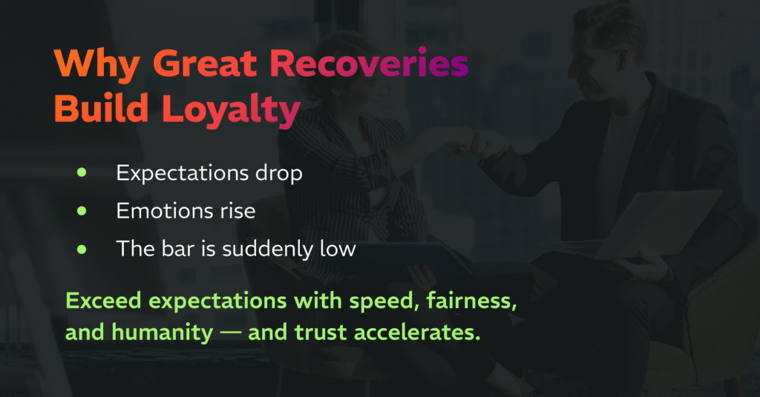
When something breaks, expectations drop. The customer is disappointed, frustrated and maybe even anxious. If our response is slow, defensive or just “OK,” we might drag the relationship back to neutral, at best. But when we respond in a way that far exceeds what they were expecting in that low moment — fast, fair, generous and human — we create a powerful emotional contrast.
We don’t just fix the issue. We prove who we are.
Todd managed to earn the upside of that equation even though he didn’t cause the problem. He voluntarily chose to own the outcome, coordinate with the dry cleaner and make the resolution simple and fair for me. In doing that, he turned a bad experience I was having somewhere else into a loyalty-building moment for his brand.
This is what a customer-centric mindset looks like in action: choosing relationships over transactions, even when it’s inconvenient.
3 Examples of the Service Recovery Paradox in Action
The service recovery paradox shows up in different ways. .
Ritz-Carlton Turns an Inconvenience Into a Signature Moment
On a trip to St. Thomas, I lost my sunglasses while paddleboarding. I didn’t report it or ask anyone to intervene. It was a minor personal loss, not a service complaint.
Later that day, a Ritz-Carlton employee approached me, asked whether I’d lost my sunglasses and handed them back. The team had overheard what happened and gone into the ocean to retrieve them. A small problem became a memorable moment that deepened my connection to the brand.
Moments like this at the Ritz Carlton aren’t accidents; they come from a clear service philosophy and real empowerment, so employees are trusted to notice issues and act decisively on behalf of the customer.
JetBlue Turns a Meltdown Into a Public Commitment
In commercial aviation, delays, cancellations and long ground holds are part of the operating reality. When disruptions stack up, customers feel stuck and powerless.
After a highly visible operational failure, JetBlue responded by introducing the JetBlue Customer Bill of Rights — a public framework that spells out how they’ll communicate during disruptions, when deplaning will occur and how specific compensation applies in different scenarios. Recovery moved from one-off negotiation to a standing promise about how the airline will behave when things go wrong.
When failure is inevitable, codifying your recovery promise in plain language and real dollars can turn a reputational low point into a longer-term story about reliability and accountability.
Slack Makes Reliability a Shared Risk
In a platform like Slack, outages have an immediate impact: Conversations stall, coordination breaks down, and work stops. Reliability is central to the value proposition.
Slack gets ahead of that risk directly in its service-level agreement. The company sets explicit availability targets and ties shortfalls to service credits. When Slack misses its uptime commitment, customers are eligible for meaningful credits against future spend. The company is sharing the financial consequences of failure.
In high-stakes, always-on environments, tying financial outcomes to your performance turns recovery from a gesture into a concrete signal that you’re willing to carry part of the risk when you fall short.
6 Steps to Turn Customer Problems Into Opportunities
That’s the same choice we face as leaders every time something goes wrong — whether we caused the problem or not.
So how do we handle customer complaints in a way that consistently turns problems into opportunities?
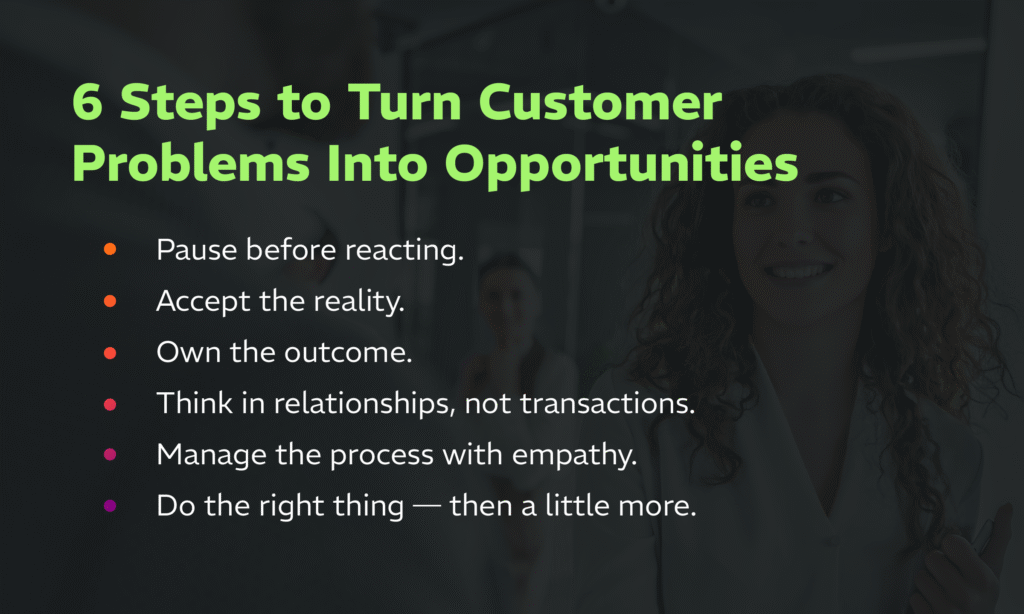
1. Pause Before Reacting
Here’s what shows up first when a customer complains: Emotion. Not logic.
We feel misunderstood. We feel attacked. We want to explain all the work that went into doing it “right.” That’s human. It’s also where a lot of service recovery efforts go sideways.
Don’t fire off the email. Don’t jump into the call to defend the team. Take a breath and regulate your own response first. That small buffer is what allows you to respond with intention instead of instinct.
Before you do anything else, ask: “What is our reality?” Our reality is that we have an unhappy customer or partner. That’s the starting point. Not whether we’re technically at fault. Not whether the contract language covers us. We begin with the human experience in front of us.
2. Accept the Reality and Seek to Understand
Once you’ve paused, move into curiosity. Something didn’t land. Someone is frustrated. If you want to build trust in these moments, you have to start by accepting that reality and seeking to understand it.
I’ve found that the best recovery conversations sound less like customer service scripts and more like genuine questions: “I can see this has been frustrating. Tell me what you were expecting.” Or, “Help me understand where this created risk or pressure for you.”
You’re not arguing with their perception. You’re not rushing to defend your process. You’re trying to see the situation through their lens. That’s human-centered leadership in action: We honor the experience before we rush to explain the execution.
Your job in this phase isn’t to win a debate about who’s right. Your job is to listen long enough that the customer feels seen, heard and taken seriously — even if the original mistake happened somewhere else, like it did with Todd and the dry cleaner.
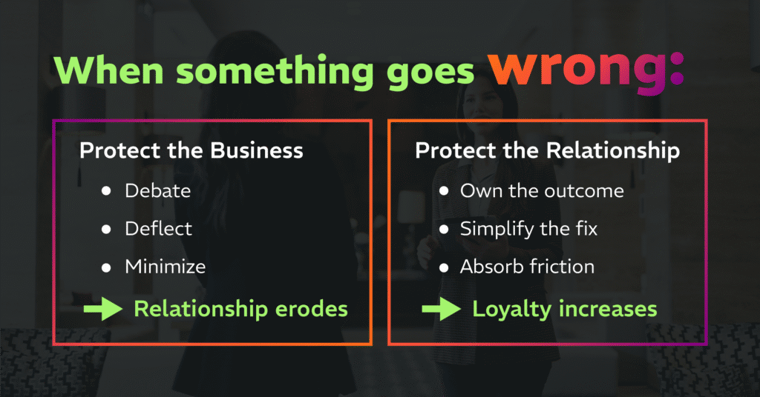
3. Stop Debating Fault and Start Owning the Outcome
This is the pivot point.
When a complaint lands, most organizations reflexively ask one question: “Whose fault is this?” Legal wants to know. Finance wants to know. And if we’re honest? Our ego wants to know.
But there’s a better set of questions if we actually want to turn this into an opportunity:
- “What does this moment require of us?”
- “What outcome would restore trust?”
- “Where is the opportunity we’re not seeing yet?”
Customers don’t stay loyal because we perfectly evade blame. They stay loyal because someone stepped up and said, “I’ve got this. I’m going to own this problem like it’s mine.” That’s exactly what Todd did. He didn’t make the mistake. He still chose to own the solution. That shift — from defending to owning, even when you didn’t create the issue — is often the moment when a tense interaction starts to turn.
4. Think in Terms of Relationships, Not Transactions
The dry cleaner saw a $500 problem. Todd was thinking in terms of lifetime value, referrals and reputation.
I see this all the time in sales organizations. Leaders optimize for quarterly targets, individual deal velocity, close rates on a dashboard. And they miss the bigger picture: The customer who stays for a decade is worth 20x more than the one you squeeze for margin today.
When you’re deciding how to respond to a complaint, zoom out and ask yourself: How long has this customer been with us? What’s the potential lifetime value if we get this right? What story do we want them to tell about us after this is over?
Human-Centered Growth is about exactly this kind of decision-making. We don’t make reckless promises. But we are willing to take a short-term hit to protect long-term trust, loyalty and brand. That’s how you turn a problem into an inflection point for the relationship instead of a fracture.
5. Manage the Process With Empathy and Ownership
Once you’ve committed to owning the outcome, the way you manage the process matters as much as the final answer.
Behind every complaint is a person under pressure — a customer whose credibility is on the line, a leader who stuck their neck out for your solution, a team that just needed this to work.
So respond quickly. Give updates before they have to ask. Make it obvious their problem has become your problem, even if you didn’t create it.
Think about the organizations we rave about when something goes wrong. It’s not just that they fixed it — it’s that someone stayed with us in the mess, took responsibility and navigated the recovery with care. That’s what Todd did. He didn’t shrug and say, “Tough break.” He said, “Let me see if I can’t handle that,” and then he stayed with it until it was done.
6. Do the Right Thing — and Then a Little More
Turning customer complaints into opportunities requires closing the loop with integrity and a small over-delivery. Apologizing is important. Fixing the core issue is essential. But the real opportunity lies in the make-good.
Sometimes “the right thing” is expensive and inconvenient. You comp the service. You redo the work. You negotiate a solution, like Todd did, where multiple parties share the cost so the customer can move forward.
Then you add a small, meaningful +1% on top:
- A personal note from a leader
- A faster-than-promised turnaround
- An upgrade or added value that says, “You matter more to us than this mistake”
Resolution is expected. Effort is remembered.
When you approach complaints this way, they stop being purely operational headaches. They become proof points of your culture. Stories your customers repeat because they can’t believe how well you showed up — especially when you didn’t have to.
Problems don’t weaken relationships — they deepen them. Many of the strongest partnerships I’ve seen aren’t built in moments of perfection, but in moments where there were mistakes and someone stepped up, took ownership and made it right.
The Moment of Truth
The problem is rarely the problem. The response is.
When something goes wrong, it’s easy to slip into protection mode — to explain, defend, or minimize. Fear creeps in. And when fear leads, we miss what the moment is actually offering us.
The best leaders understand that problems create moments of truth. Not moments to prove we’re right, but opportunities to show who we are. This is human-centered leadership in action. Practical, disciplined and deeply effective.