Too often, we try to move buyers through our pipeline — on our timeline, with our messaging — without considering where they are in their decision journey.
But customers don’t care about our process. They follow their own, and that journey isn’t linear. It’s emotional, complex, and filled with competing priorities. It involves internal politics, perceived risk, and a whole lot of second-guessing that has nothing to do with us.
In fact, Gartner research finds that active B2B buyers spend only 17% of their time meeting with potential suppliers. When they’re comparing multiple vendors, the time spent with any one sales rep may be as little as 5% or 6%.
It’s not that buyers don’t need us anymore. They need something different. They need a partner who is patient, present and ready to adapt with them. Every conversation is a chance to move closer or create friction.
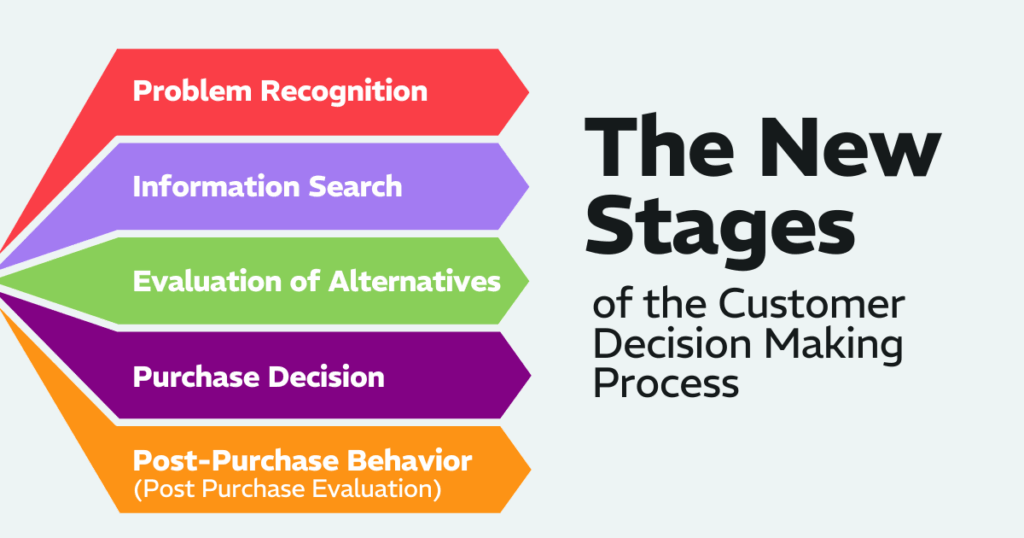
The New Stages of the Customer Decision Making Process
The customer decision making process (often described in B2C as the consumer decision making process or consumer buying process) is the set of stages a customer moves through to choose products or services.
Success requires understanding the customer journey and showing up with the right insight, empathy, and value at each stage of the buying decision process.
Problem Recognition
Most journeys begin with problem recognition. Something isn’t working or perhaps it could be working better. The spark may come from internal or external stimuli: a missed target, a new competitor, a customer complaint, or a compliance change.
Effective marketing campaigns and a clear marketing strategy can also surface pain and frame opportunity. Your role is to help buyers name the problem in their language and imagine what changes if they address it now.
Information Search
Once the need is clear, buyers begin gathering information. During this information search stage, they turn to peers, analysts, review sites, and social media long before they talk to sales. They consume content and compare products or services side by side.
If you aren’t present where buyers are learning, you’re already behind. Show up to clarify, not to overwhelm.
Evaluation of Alternatives
With information in hand, buyers assess their options and that includes doing nothing. At this stage, fit and confidence matter more than a feature checklist to a potential customer. Do they believe you understand their world? Do they see you as a partner who can reduce risk and deliver results?
Relevance is your advantage. Tailor the narrative to stakeholder priorities, share proof that looks like them, and equip champions to carry a clear value story internally.
Purchase Decision
As the group leans toward a final decision, logic and emotion still matter. Concerns about timing, change management, and perceived risk can stall progress even when the numbers work. The best sellers don’t push harder; they de-risk the decision. Map an adoption plan, align roles, and make the next step feel proportionate and safe.
Post-Purchase Behavior (Post Purchase Evaluation)
The journey doesn’t end with a signature. In post purchase evaluation, customers assess whether expectations were met and whether the experience matched the promise. This is where brand loyalty is earned, repeat purchases are influenced, and advocacy takes root.
Keep showing up. Celebrate early wins, measure impact, and ensure customers see the return on their investment. Post-purchase engagement is where sales professionals transform one-time buyers into lifelong advocates.
7 Signs Your Sales Process Isn’t Aligned With the Stages of the Consumer Journey
Most deals don’t fall apart because of product gaps or price. They fall apart in the disconnect between the experience we’re creating and the way customers actually make a buying decision. Some of the signals are obvious; others are subtle. If we’re willing to take an honest look at our customer journey, we can spot the patterns and realign our approach.
You’re Repeating Your Pitch
When the story doesn’t land early, hesitation is a rational response. If we’re re-telling the same pitch meeting after meeting, it’s often because our message hasn’t been framed in the buyer’s language or anchored to outcomes they own. Early in the consumer decision making process, build a simple, shareable value narrative that connects the work to measurable impact. A good test: Can your champion retell the story without you? If not, tighten it until they can.
The Deal Slows Down as More People Get Involved
B2B buying decisions are made by teams, not individuals. Each stakeholder shows up with different priorities, incentives, and concerns. When new voices arrive late and we’re forced to rewind the conversation, it’s a sign we didn’t map the decision team or equip our champion to build consensus. This isn’t a stall tactic; it’s how organizations protect themselves from risk.
Your Internal Deal Stages Are Progressing, But the Buyer Isn’t
Progress in a CRM doesn’t always reflect progress in the room. We can advance from demo to proposal while the customer is still undecided, because emotional readiness often lags behind technical validation. When confidence isn’t moving, the buying decision won’t either.
You’re Doing Most of the Talking
Overloaded buyers don’t need more information; they need clarity. If a meeting is wall-to-wall slides, we might leave feeling productive while the customer leaves with more questions. Professional listening is how we reduce complexity and help people make sense of what matters.
The Conversation Shifts to Price Too Early
Buyers don’t start with price; they default to price when value isn’t clear. If our message sounds interchangeable or doesn’t connect to their priorities, cost becomes the only practical way to compare options.
Interest Is High During the Demo, Then Things Go Quiet
A demo should validate a story that’s already been told, not introduce one from scratch. If enthusiasm fades after the meeting, it’s usually because the experience was product-first instead of customer-first.
Handoffs Between Teams Create Confusion
When marketing, sales, and customer success teams aren’t operating from a shared view of the customer, the result feels fragmented. Confidence erodes quickly when the promise and the experience don’t match.
If any of these issues sound familiar, even small adjustments can help remove friction, restore buyer confidence and improve sales team performance.

Key Factors That Influence the Consumer Decision Making Process
If you want to sell the way people buy, look beyond features and functionality. Modern decision-making is shaped as much by psychology and perception as it is by price or product specs. A high-performing sales team knows that these forces carry outsized weight in the customer decision-making process.
Risk vs. Reward
Every purchase is a bet. Buyers weigh the potential upside of solving a problem against the downside of making a costly mistake. In fact, perceived risk often outweighs potential reward. That’s why a proposal that looks perfect on paper can stall when fear creeps in. Your job is to lower the stakes. Paint a clear picture of outcomes, provide evidence of success, and de-risk the decision so the reward feels worth pursuing.
Credibility
In an age of information overload, trust is the ultimate differentiator. Buyers ask: Can I count on you? Do you understand my world? Will you deliver what you promise? Every interaction is an opportunity to answer those questions. The way you listen, the stories you tell, and even how you show up in moments of uncertainty all either build or erode credibility. Without trust, the best proposal in the world won’t get signed.
Social Proof
People don’t buy data points. They buy stories. When buyers hear how peers in their industry solved similar challenges, it makes the decision feel safer. That’s why case studies, testimonials, and even a simple anecdote can tip the scales.
Clarity
Complexity is the enemy of progress. When buyers are overwhelmed by jargon, endless options or competing priorities, they stall. The most effective salespeople simplify the landscape. They translate complexity into clear choices, highlight what matters most, and make the path forward easy to understand. Simplicity builds momentum, and momentum carries decisions across the finish line.
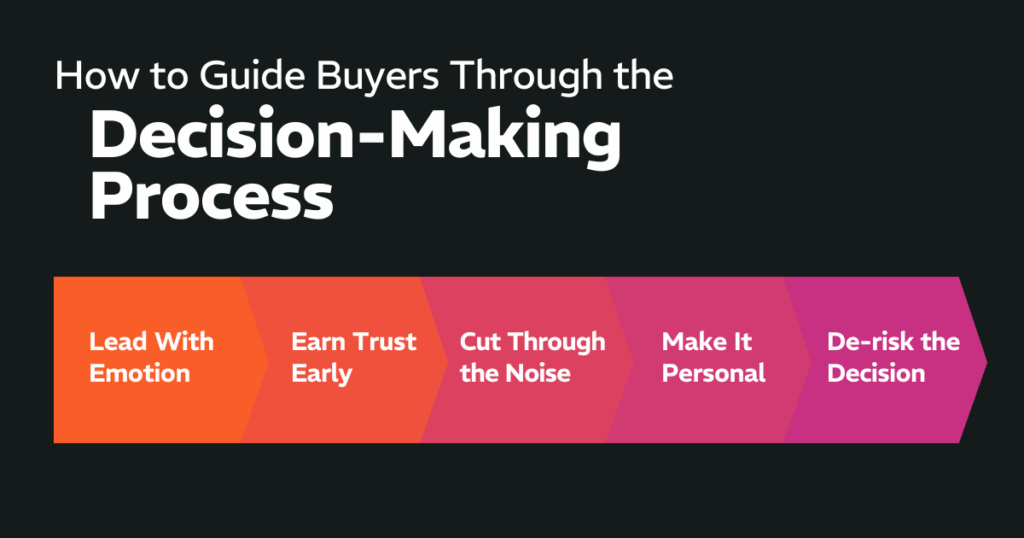
How to Guide Buyers Through the Decision-Making Process
If the modern consumer buying process is nonlinear and uncertain, our role is to provide clarity and confidence at every stage.
Lead With Emotion
Buyers make decisions emotionally, then justify with logic. Start with their story, not your slide deck. Get curious about what’s at stake for the business and the people making the decision.
Earn Trust Early
You don’t earn the right to close until you’ve earned the right to be trusted. Build credibility through preparation, honesty and consistent insight.
Cut Through the Noise
Your buyer isn’t short on information — they’re drowning in it. Help them sort signal from noise. Offer perspective that simplifies, not content that overwhelms.
Make It Personal
Relevance wins. Use the buyer’s language. Tie your message to their priorities and to the outcomes they own. If they can’t see themselves in your solution, they won’t move forward.
De-risk the Decision
Most deals stall on fear. Make the next step feel safe and proportionate. Show how you’ve done it before, outline what happens after signature, and keep post purchase evaluation in mind from day one.
Sell the Way People Buy
The days of controlling the conversation are gone. Your customers are in charge now. They’re armed with information, shaped by peer influence, and motivated by both the promise of reward and the fear of risk.
That’s why the real job of sales is alignment with the customer. Sales teams that pivot away from persuasion and toward guidance create a competitive advantage. They help customers buy with confidence.
If you’re ready to transform your sales processes to align with the customer’s needs, start by downloading the Human-Centered Growth Playbook. Inside, you’ll find a practical, people-first model for building high-performance teams, strengthening culture, and leading through complexity with clarity, connection, and purpose.
These same principles come to life in our sales keynote. Book a call to learn more.