The skills required to win are changing. The training programs most organizations are running aren't.
According to Gartner research, 72% of sellers feel overwhelmed by the number of skills their job now requires — and overwhelmed sellers are 45% less likely to hit quota. Who does deliver on the target? Sellers who effectively partner with AI tools are 3.7 times more likely to meet quota than those who do not. Sellers who are learning.
I know this is a question I've been asking myself a lot recently: Does our sales motion align with the shifts in the B2B buying environment? Are we upskilling the competencies that have the most significant impact on commercial results?
The importance of sales training has never been more consequential — or more urgent to get right.
What Is Sales Training?
Sales training is the process of developing the skills, knowledge and behaviors that enable sales professionals to perform at their best, from prospecting and discovery through objection handling, negotiation and close. How you deliver it matters as much as what's in it.
A well-designed, immersive training event is one of the most powerful investments a sales organization can make. When people are in the room together, the resonance is different — the shared experience, the collective commitment to growth. It creates alignment, builds momentum and creates the conditions for real behavioral change.
What determines whether that change actually takes hold is what happens before and after. Hermann Ebbinghaus's forgetting curve — one of the most replicated findings in cognitive science — established that humans begin losing newly acquired knowledge within hours without reinforcement. Sales training is not immune to this. What closes the gap between what gets taught and what gets executed in the market is reinforcement — before, during and long after the event itself. When the room clears, the real learning begins. That's what effective sales training actually looks like — not an event, but a system. Training never stops.
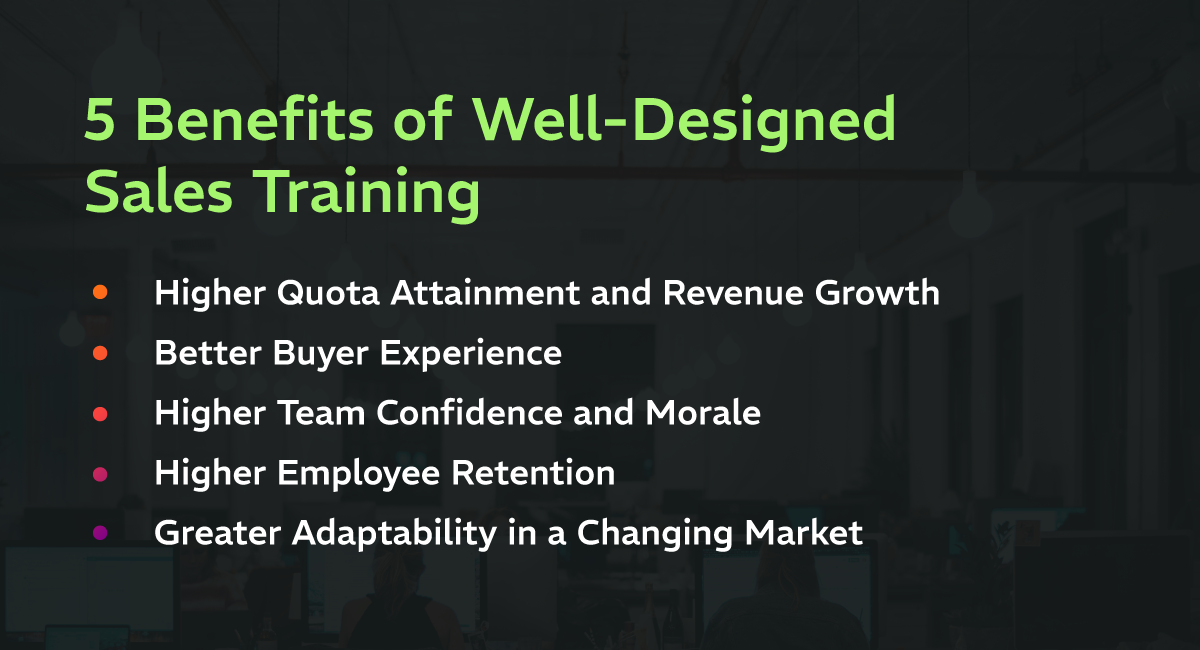
5 Benefits of Well-Designed Sales Training
High-performing sales organizations are twice as likely to provide ongoing training as low performers. The investment gap is real, and so are the returns. When training is designed well and reinforced consistently, the results compound across the entire sales organization.
Higher Quota Attainment and Revenue Growth
Reps who know how to run a sharp discovery, handle objections with confidence and guide a buyer through a complex decision close more deals, shorten the sales cycle and win higher-value contracts. Those aren't personality traits. They're skills, and skills are built through consistent training and coaching. The teams that invest in developing them outperform the ones that don't. That's not a theory. It shows up in win rates, quota attainment and the bottom line.
Better Buyer Experience
Harvard Business School professor Gerald Zaltman found that 95% of purchasing decisions take place in the subconscious mind. Buyers bring their prior experiences, their instincts and their existing beliefs into every conversation — they decide emotionally and rationalize afterward with logic.
That finding changes the seller's job description. The job isn't to present information. Customers have more information than they know what to do with. The job is to guide: to help someone make sense of competing priorities, work through real organizational complexity and arrive at a decision with confidence. That requires active listening, discernment and the ability to build trust at every stage of the sales cycle. It's fundamentally human work — and increasingly rare in a world of automated outreach and AI-generated content.
The best sellers I've been in are powered by technology and completely human-centered in every interaction. That orientation doesn't arrive fully formed. It's built through training, reinforced through coaching and refined in the field.
Higher Team Confidence and Morale
There's a dimension of great sales training that won't show up directly in a revenue report, but it matters just as much. It's what the experience does for the sales reps going through it.
Most sellers right now are carrying more than the job used to ask of them. When a sales organization invests in development that is relevant, well-designed and connected to the actual work, it sends a clear message: we believe in this team. A great training experience gives sales reps both the capability to do the work and the confidence to go out and succeed. That combination of skill and belief is what separates a team that performs under pressure from one that waits for conditions to improve.
Higher Employee Retention
Top-performing salespeople have options. When they stop growing, they leave. The cost goes far beyond the recruiting budget.
The organizations I see retaining their best people aren't doing it with compensation alone. They're doing it by building an environment where growth is expected and supported — where people feel coached, challenged and invested in. That signal compounds. People who are developing want to stay. They bring others up. They become the culture. Companies grow when people do. That dynamic runs just as powerfully in reverse.
Greater Adaptability in a Changing Market
The concept I keep coming back to is talent velocity: an organization's ability to identify the skills it needs, build or acquire them and mobilize its sales force ahead of market shifts. X-Team's 2026 AI Talent Readiness Report found that skills development consistently surfaces as a top barrier to scaling AI, and that most organizations who name it as their primary constraint have no structured training program in place to address it. Recognition of the problem hasn't translated into organizational design.
The organizations winning right now closed that gap on purpose. The ones falling behind are still running programs designed for a market that no longer exists.
How to Make Your Sales Training More Effective
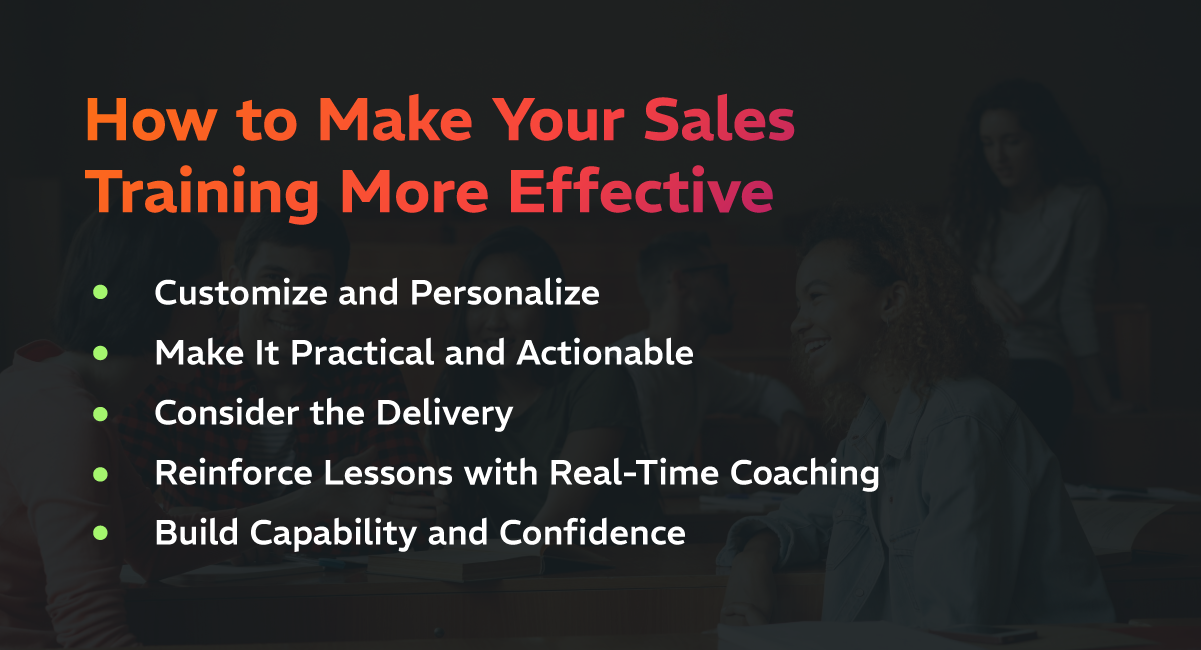
The difference between development that changes behavior and training that gets forgotten by Friday comes down to five things.
Customize and Personalize
Generic training about sales techniques doesn't move the needle. The program has to be nuanced and relevant — built around that particular set of sellers, their sales skills, their industry, their sales process and their deal structure. That starts with choosing the right sales training topics for your team's specific gaps and market. If it doesn't reflect the actual work your team is doing, it simply isn't relevant enough to matter.
Make It Practical and Actionable
Sales professionals need to move through real-world scenarios, such as role play, live practice and actual objection handling, and walk away with insight they can apply immediately. Going beyond product knowledge to develop the consultative sales training techniques that drive results is where the real work is. Inspiration alone isn't enough. You have to be able to take the learning into the market and refine it over time.
Consider the Delivery
There is still tremendous value in being face to face — the resonance is different, and I think that's as true for training as it is for selling. But technology gives us the tools to extend the learning well beyond the event. Pre-work, post-work, action planning — all of it matters. The room clearing is not the finish line. It's the starting point for continuous learning.
Reinforce Lessons with Real-Time Coaching
The investment in training doesn't stand alone. Sales managers have to reinforce what was learned in the field, in deal reviews, in every coaching conversation. Every time a sales rep engages a customer, wins a deal, or takes a loss, there's a learning opportunity. The best sales leaders take the time to audit and deconstruct those experiences with their teams. That's where knowledge actually transfers, and it's the foundation of how to improve sales training results over time.
Build Capability and Confidence
A great training experience gives people both. The skill to do the work and the belief that they can go out and succeed. When you get that blend right, you're not just running a program. You're building a team equipped to compete and win.
Invest in the People Doing the Work
The best investment you'll ever make is in the people doing the work — starting with yourself. That is why everyone, including me, should have both a business plan and a development plan running simultaneously.
I bring this work directly to enterprise sales teams through the Sell for Impact keynote. The program is built around the same principles outlined here: personalized, practical, reinforced and rooted in the human capabilities that technology can't replace. It's designed to shift the mindsets, skills and habits that separate sales organizations that compound their results year over year from those that plateau. If your team is ready to close the gap between where it is and where the market is heading, this is where that work begins.