

One topic has dominated the agenda of every SKO I have participated in so far in 2026: The adoption of artificial intelligence and more precisely, deploying agentic AI to create measurable business value.
The commercial application is real. Companies that invest in AI are already seeing a revenue uplift of 3 to 15 percent and a sales ROI uplift of 10 to 20 percent, according to McKinsey reports.
The speed, automation and intelligence these tools are able to unlock are clearly a productivity multiplier.
However, the commercial teams who win in the era of complexity won’t necessarily be the ones that move the fastest. They’ll be the ones who understand that human discernment powered by generative technology to deliver a POV that is most relevant to the customer is where partnerships happen.
Yes, speed counts. Speed with precision and compelling differentiation wins.
In this new environment, the enduring competitive edge isn’t artificial intelligence. It’s authentic intelligence.
Artificial Intelligence vs Authentic Intelligence
Artificial intelligence is research, data aggregation, synthesis and automation in overdrive. It’s ruthlessly fast and efficient.
It’s also borrowed thinking.
Every team in your category has access to the same models, the same tools, the same outputs. When the infrastructure is shared, the outputs converge. The proposals start to sound alike. The content hits the same notes. The follow-up emails read like everyone else’s follow-up emails. What AI scales at this level of adoption isn’t advantage — it’s volume. And volume without differentiation is noise.
Authentic intelligence is the integration of AI with your unique IP, your history, your customer insights and your own judgment mapped to a customer’s unique situation and outcome objectives. It’s what happens when you layer the speed of AI with human intelligence and discernment to help a customer make sense of the data and complexity so they can make the best decision.
That distinction matters more than most commercial teams realize right now. A first-mover advantage in AI has a shelf life. The team with the best tools in Q1 watches their competitor match them by Q3. But an organization that has built its own knowledge architecture underneath the tool — its history, its IP, its customer patterns, its frameworks — has something no competitor can spin up with a new subscription. That’s not a marginal edge. That’s a structural one.
Artificial intelligence scales volume. Authentic intelligence scales value.
How to Unlock Your Authentic Intelligence
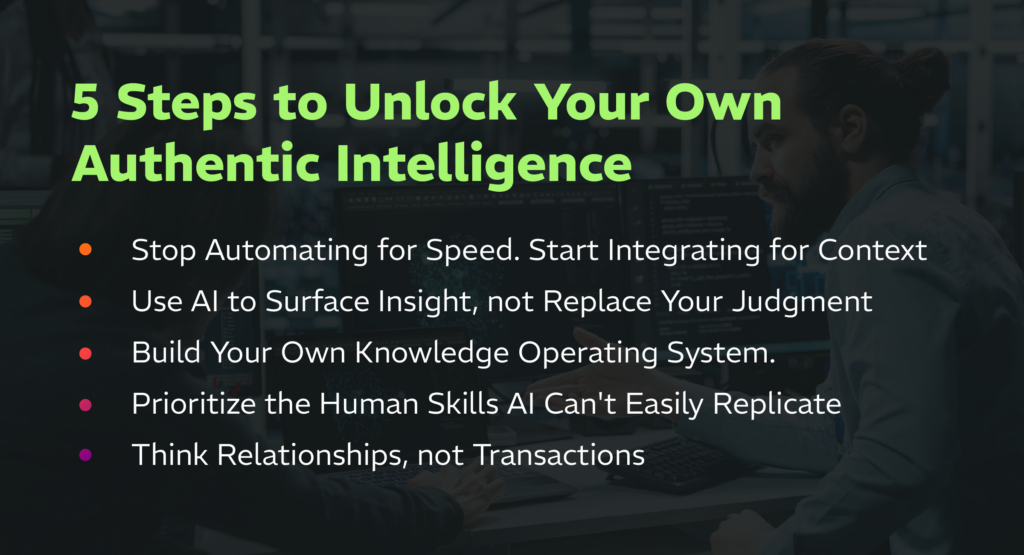
So how do you shift from using AI as a tool to building authentic intelligence as a system? These steps are a great start.
Stop Automating for Speed. Start Integrating for Context
AI can produce a pitch deck in minutes. But without your insights layered in, it’s inherently generic. The goal is richer, more precise thinking that reflects your unique point of view and delivers real time value for the customer.
Use AI to Surface Insight, not Replace Your Judgment
The technology can analyze data, identify patterns and synthesize research. But it can’t tell you why someone is hesitating or what matters most to this customer at this moment. That’s our job. Real problem solving still requires a human in the room. Leverage AI to do what it does best, then apply your experience and expertise to make sense of what it means.
53% of sales professionals say it’s harder to sell than a year ago, according to Salesforce’s State of Sales report. Part of what’s making it harder is the paradox of more — more data, more tools, more information arriving faster than anyone can process. The reps who are cutting through are the ones who can take everything AI surfaces and apply the discernment that only comes from expertise and experience: why this buyer is stuck, what they’re not saying out loud, what it will actually take to move them forward.
Build Your Own Knowledge Operating System.
The companies winning with AI aren’t the ones prompting ChatGPT the most. They’re feeding their own history, IP, customer feedback and market knowledge into systems that produce outputs grounded in their truth. If your AI doesn’t know your story, it can’t help you tell it.
We’ve been building this for ourselves. Every keynote transcript, client brief, discovery call, framework and case study is being organized, synthesized and connected into a system that functions as both my thought partner and customer intelligence hub. When I’m preparing for a real estate audience, I’m not starting from what the internet knows about real estate. I’m starting from what I know: every relevant story I’ve told, every client insight I’ve gathered, every module I’ve refined over years on stage, and I’m able to apply that to everything I’ve learned about the customer’s needs and goals. That architecture is the difference between content that sounds like everyone else in your category and content that couldn’t have come from anyone but you.
Prioritize the Human Skills AI Can’t Easily Replicate
Creativity. Empathy. Storytelling. Discernment. These are still your competitive moat. Artificial intelligence makes you faster. Authentic intelligence makes you an indispensable partner.
Here’s what AI won’t do: bring the scar tissue. The client who walked away, the deal that fell apart, the moment something clicked that you can’t explain but know how to use. That accumulated, imperfect, deeply human experience is not a liability in the AI era. It’s the most valuable asset. The question is whether you’re investing in it or outsourcing around it.
Think Relationships, not Transactions
AI can help you scale outreach, automate follow-up and optimize messaging. But it can’t care about someone’s problem. It can’t sit with ambiguity. It can’t make a customer feel seen, understood and valued. That’s on us—and it’s what they’ll remember the most.
What I know to be true: I want you to care about my problem almost as much as I do. When you’re sitting across from a customer, that’s what they want too. Not more information. Not a faster follow-up. A partner who can help them make sense of the information and is genuinely invested in helping them make the right decision. At its best, selling is an act of service — one problem solved, one person served, one decision made with confidence. AI can scale the process around that relationship. It cannot create trust in the relationship itself. The commercial teams who understand that distinction and build their AI strategy around it — rather than as a replacement for it — are the ones who will have an advantage today and still be winning five years from now.
My guiding principle: Automate the tangible. Humanize the intangible. Deliver more value.
Why Authentic Intelligence Is Your Real Force Multiplier
The competitive advantage of AI alone has a shelf life. What compounds is what you’ve built underneath it — your IP, your customer insights, your judgment applied to a specific person at a specific moment who is counting on you to help them make the right call. That’s where authentic intelligence thrives. And it’s what will still be winning long after the tools everyone else is using have become table stakes.


