Learning how to overcome sales challenges starts with a recognition many leaders don’t want to face: The problem isn’t your product, your process or even your people. The challenge is that you’re serving a different type of buyer than you were a few years ago.
Today’s buyers are self-educated, overwhelmed and skeptical. They’ve tuned out generic pitches and learned to avoid salespeople until the last possible moment. And when they do engage, they’re looking for something your product demo can’t deliver: clarity, confidence and a partner who actually understands what they’re up against.
Let’s break down the biggest challenges sales teams face today and explore how a Human Centered Framework can help you lead through them with clarity and momentum.
Why Sales Has Become More Challenging Today
Three shifts explain why sales strategies that worked a few years ago are now behind stalled deals and missed numbers.
Buyers Now Do Most of the Work Without You
A 2026 Gartner survey found that 67% of B2B buyers now say they’d prefer a rep-free buying experience entirely. A separate Gartner survey found that 73% of buyers actively avoid vendors whose outreach doesn’t feel relevant to them. The window to earn attention has never been smaller, and most sales teams aren’t built to reach buyers that early in the process.
More People Now Have to Say Yes
A typical B2B purchase now runs through a buying group with real internal friction: a Gartner survey found that 74% of B2B buyer teams show unhealthy conflict during the decision process. Selling to one champion isn’t selling anymore. It’s coordinating a consensus among people who don’t already agree.
Indecision Is the Real Competition
Sales teams rarely lose deals to a competitor. They lose them to inaction. Forrester research puts the share of B2B purchases that stall out somewhere in the process at 86%. Buyers don’t choose someone else nearly as often as they choose to do nothing.
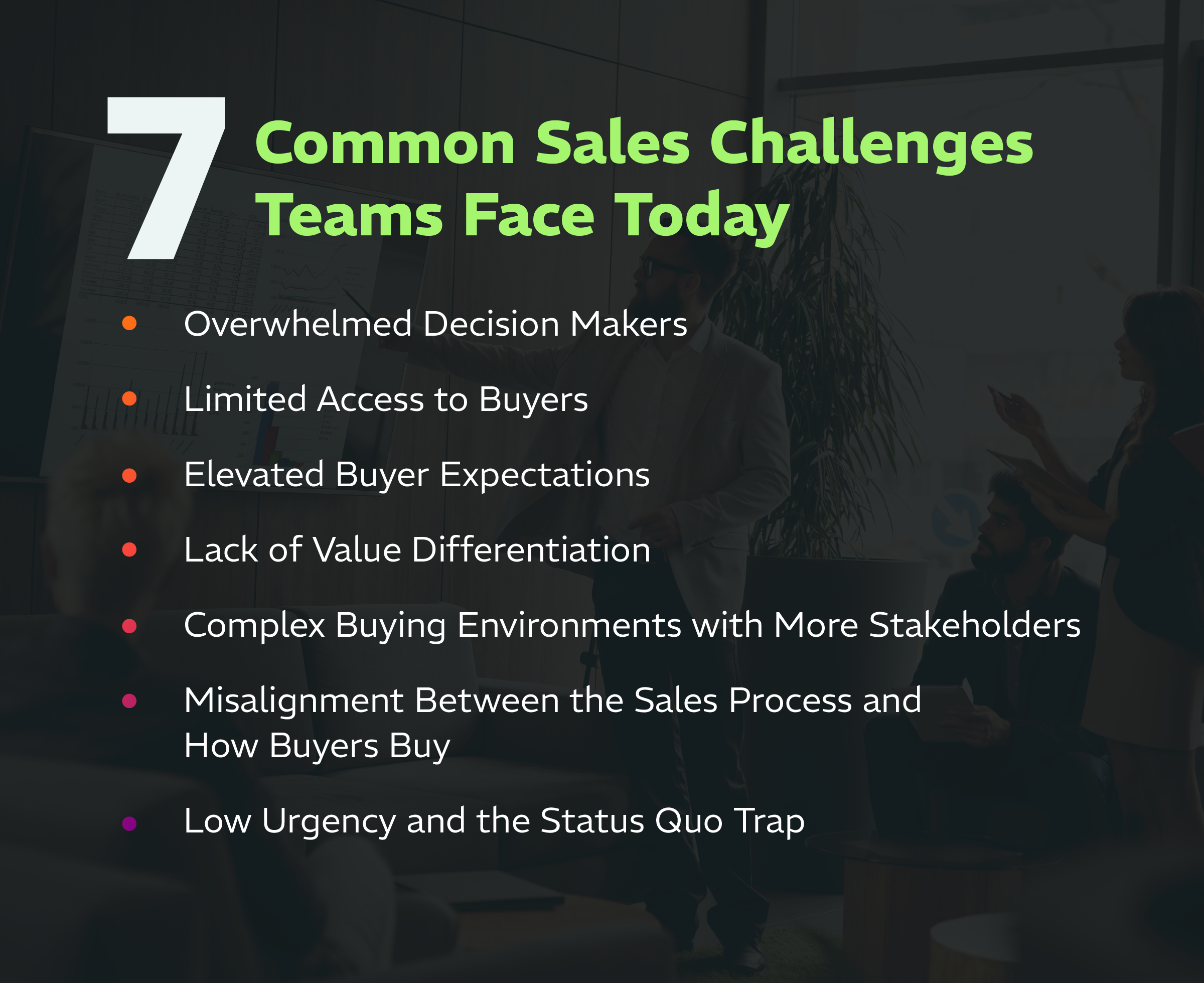
7 Common Sales Challenges Teams Face Today
Want to reduce long sales cycles and improve win rates? Start with what stands between you and closing deals. These are the sales team challenges and sales management challenges quietly stalling growth right now.
Overwhelmed Decision Makers
Information overload has left buyers exhausted. Even when they see the value, many simply can’t commit, and the deal stalls instead of closing or dying outright.
The fix isn’t more content. It’s less noise. The best sellers act as sensemakers, guiding buyers through a clear decision path instead of adding to the complexity they’re already drowning in.
Trade the pitch for a diagnostic. Ask questions that help buyers organize their own thinking. Build a data-driven framework that makes the next step obvious. Cut through the clutter for someone and you stop being another vendor.
Limited Access to Buyers
Self-educated buyers spend a shrinking share of the process talking to a supplier, and that share splits even further once multiple vendors are in the mix. The window to make an impression keeps shrinking.
Building relationships over time isn’t a strategy anymore, not when there’s barely time to build one. Credibility has to exist before the first conversation. Your content, your point of view and your reputation are doing that work with potential customers now, not your first call.
Invest in insight selling instead of information selling:
- Share a real point of view through content and community, not just product features
- When you do get face time, teach the buyer something they didn’t already know
- Treat every interaction as though it’s the only one you’ll get
This is what modern sales techniques require now: speed to insight, not speed to pitch.
Elevated Buyer Expectations and Behavior Change
Buyers have done their homework. They don’t need a rep to explain what a product does. They need something they can’t already look up: a new way to see their own problem.
That’s the shift from product expert to trusted advisor, and it’s what earns the right to guide both the conversation and the deal. A customer-centric mindset isn’t a value statement on a website. It’s what separates a seller worth a meeting from one who isn’t.
Lack of Value Differentiation
Teams that can’t articulate what makes them different default to price, and that race to the bottom costs margin and brand equity alike.
There’s a simple test for this: can your team answer what you do that the competition cannot or does not, that the buyer covets and cannot live without? If not, price pressure isn’t the real problem. The absence of a real answer is.
Differentiation lives in the buyer’s problem, not your product sheet. Diagnose the cost of the problem you solve. Quantify it. Tell the story of a customer who solved it with you instead of listing features. Master value selling and price becomes a footnote instead of the headline.
Complex Buying Environments with More Stakeholders
You’re rarely selling to one decision maker anymore. You’re facilitating a group decision among people with different incentives, different risk tolerance and different reasons to say no.
Your job shifts from persuading a buyer to equipping a champion. Map the buying group early. Identify who has influence, who holds the budget and who could block the deal. Coach your champion on the objections other stakeholders are likely to raise, and hand them the tools to make your case when you’re not in the room.
Misalignment Between the Sales Process and How Buyers Buy
Buyers don’t move through a linear funnel. They move through digital channels, peer conversations and social proof, often out of order and often without telling you. A sales process built around your pipeline stages instead of their decision path loses deals it should have won.
Map the buyer’s journey instead of your own. Understand the questions and concerns that show up at each stage, then build content and engagement around those, not around your quota. A rigid process breaks against buyers who don’t move in straight lines. Flexibility is what keeps pace with them.
Low Urgency and the Status Quo Trap
Even a buyer who sees the value can lose to their own comfort with the familiar. Inaction feels safe. It rarely is.
Pressure tactics don’t fix this. Clarity does. Quantify what staying the same costs, in revenue, in efficiency, in ground ceded to a competitor. Help buyers see the gap between where they are and where they could be, specifically enough that the status quo stops feeling safe.
The Human-Centered Framework to Overcome Sales Challenges
None of these challenges can be solved with a new tool or a new script. We need a new Human Centered Model for growth.
Start with Self
Every challenge above gets harder to solve if the seller’s sense of confidence, energy and presence aren’t aligned.
Ask: When a deal stalls or a slump hits, do we default to blaming the market, or run a real self-audit: What’s working, what’s not and what we’re avoiding?
Do:
- Reconnect to real wins and customer impact.
- Treat a slump as a signal to build sales skills and experiment with a new approach, not grind the same playbook harder.
- Invest in people’s wellbeing, not just skills.
Connect in Service
Real connection doesn’t come from being easy to work with. It comes from being useful enough that a buyer trusts us to challenge their thinking, not just accommodate it. That’s the line between a relationship builder and a value creator, and buyers can tell which one they’re talking to.
Ask: Are conversations starting with a curiosity or a pitch? Are we teaching the buyer something about their own business they didn’t already see?
Do:
- Bring buyers into co-creating the solution early instead of presenting your own fully formed.
- Make every interaction personal enough that it couldn’t be reused for another account.
- Practice looping to understand on every sales call: ask an open question, probe twice, summarize back what you heard, then recommend.
Connection gets built through service that earns trust, not through rapport for its own sake.
Momentum through Harmony
A deal that closes clean rarely comes down to one moment. It’s every step landing in the right order: value established before the ask, promises that match what gets delivered, follow-ups that add something instead of just checking a box. When any of that falls out of step, momentum stalls even after the ink is dry.
Ask: If the close feels hard, is it because the value never landed, or because we skipped a step it depended on? Once a deal closes, do our commitments match what the team delivers?
Do:
- Let closing be the natural conclusion of a process run well, not an action bolted onto the end.
- Give every touch a job: new value or a specific next step, never just checking in.
- Close the loop with delivery and customer success so what we promised and what shows up stay in sync.
When the process holds together from first call to delivery, long-term momentum builds on its own instead of needing to be forced.
Your Path Forward
Overcoming sales challenges starts with people, not tools.
Ready to embed a Human Centered Growth approach into your sales organization? Download the Human-Centered Growth Playbook.