Most sales training fails. That’s a hard truth, but every sales leader I know has lived it. You bring everyone together for a workshop, fly in a facilitator, and hand out the playbooks. For a moment, there’s energy in the room. Then Monday comes, and nothing really changes.
Companies spend billions each year trying to improve sales performance, yet too often the training becomes an event to endure instead of an experience that transforms. Why? Because it doesn’t stick. It’s not relevant to what salespeople face in the field. It’s meant to check a box, and without managers reinforcing the learning, it quickly fades.
That type of sales training was built for another era. Today’s modern sales environment demands more. It demands personalization, practice, coaching, and accountability. It demands learning that mirrors the real world, not just another slide deck.
World-class sales training is about building a culture where growth is continuous, development is expected, and performance is connected to purpose. It should build confidence, resilience, and customer focus because that’s ultimately how to improve sales team performance in a way that lasts.
Why Most Sales Training Fails to Create Impact
Sales leaders want to equip their teams for success. Reps want to grow. But the way training is typically delivered doesn’t create the kind of lasting change that drives performance. Here’s why.
One-and-Done Training
Sales training is often limited to onboarding, virtual self paced learning or the sales kickoff meeting, but sales skills fade fast without reinforcement. Just like athletes wouldn’t expect to compete after practicing once, sales professionals can’t achieve mastery after a single workshop. Training that isn’t continuous quickly becomes forgotten content instead of lived behavior.
No Real World Application
Salespeople disengage when training feels disconnected from the actual challenges they face with customers. Abstract slides and generic scripts don’t prepare reps for tough objections during cold calls, sales pitches for competitive deals, or sales strategies for high-pressure negotiations.
Most salespeople can recall sitting in a training where the content sounded good in theory, but it didn’t help them on their next customer call. They walked into a meeting, faced real pushback, and realized the training hadn’t equipped them for that moment. That’s when training becomes “noise” instead of a tool for impact.
Leaders Don’t Reinforce the Learning
Managers are the force multipliers of training in every sales organization. When front-line leaders don’t model the behaviors, provide sales coaching, or celebrate progress in line with the new teaching, training fades quickly. Managers need the right sales leadership skills to act as coaches, model new behaviors, and reinforce learning until it becomes second nature.
Every salesperson has experienced this disconnect: training introduces a new framework or tool, but the manager never references it again in pipeline reviews, one-on-ones, or team meetings. Without that reinforcement, people default to old habits. On the other hand, when leaders make the new language and behaviors part of everyday conversations, training becomes part of the culture.
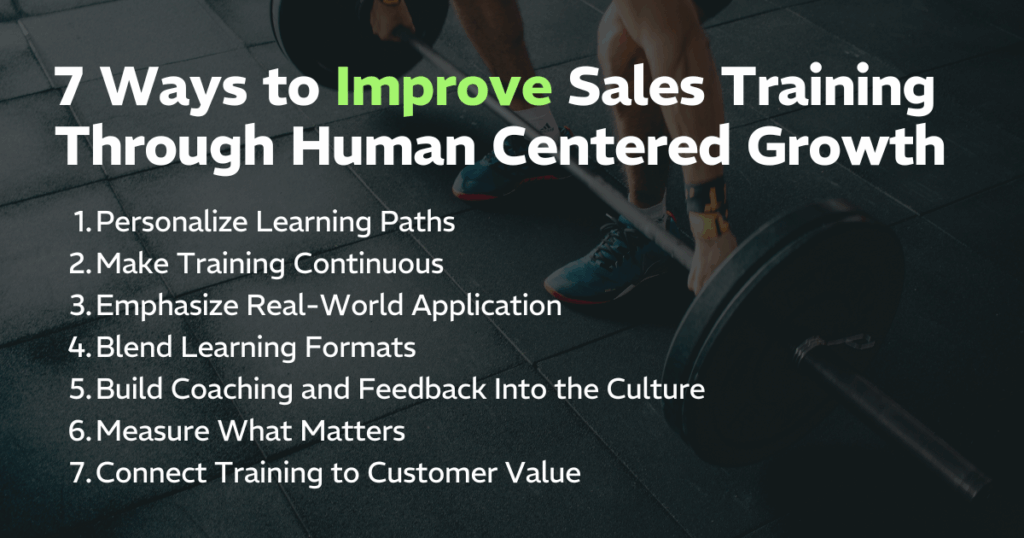
7 Ways to Improve Sales Training Through Human Centered Growth
If traditional sales training falls short, what’s the alternative? A Human Centered Growth model inspires us to designing training experiences that meet people where they are, focus on real-world challenges, and prioritize individual and organizational growth
Personalize Learning Paths
Not every rep learns the same way or needs the same skills. Modern training works best when it’s tailored to individual strengths, skill gaps, and career stages. Personalized coaching accelerates growth and keeps reps engaged.
Every sales team has the veteran who needs advanced negotiation skills and the new hire who’s still learning the basics of actively listening. When both get the same generic training, someone tunes out.
Make Training Continuous
World-class sales teams don’t view training as an event. They treat it as a rhythm, with regular refreshers, coaching, and feedback loops that build muscle memory over time.
Think of training like going to the gym. One workout won’t get you fit. Progress comes from showing up consistently.
Emphasize Real-World Application
Training should mirror the real challenges reps face, such as customer objections, competitive pressure, and tough negotiations. Role-plays, call reviews, and scenario-based learning make skills stick.
Blend Learning Formats
Today’s reps don’t want to sit in a conference room for two straight days. They expect a mix of learning that fits into the flow of work. Blended approaches, like mixing live workshops, digital modules, mobile microlearning, and even VR simulations, can meet reps where they are and engage different learning styles.
Build Coaching and Feedback Into the Culture
Managers should act as coaches first. When they model behaviors, reinforce lessons, and provide timely feedback, training becomes part of everyday sales practice.
Top performers often credit a leader who went beyond the training for their success. Someone who showed up, put in the time, and helped them grow.
Measure What Matters
Attendance and participation don’t matter if the training doesn’t deliver business outcomes. If you only measure who showed up to training, you miss the point: Did it change how they sell?
Connect Training to Customer Value
Training shouldn’t just teach reps how to make better sales calls or to close deals. It should help them think like trusted advisers, build resilience, and create meaningful value for customers.
5 Sales Training Ideas for Greater Business Impact
Once the foundation is in place, the next step is designing experiences that bring training to life. The best programs combine engagement with practical application.
Sales Training Games
Gamification brings energy and competition into learning. Leaderboards, quizzes, and challenges can motivate reps to engage and absorb product knowledge faster. When training feels like play, people lean in.
The downside? It can get superficial fast. If the games aren’t connected to real selling skills, the learning won’t stick. The key is to design gamified experiences that reinforce the right behaviors and drive real performance outcomes.
Role-Playing and Scenario-Based Learning
Role-play remains one of the most effective ways to prepare reps for the realities of selling. Practicing objections, negotiations, and discovery conversations builds confidence and creates muscle memory. It’s a safe space to fail and learn before facing customers.
The challenge is that poorly run role-plays can feel awkward or artificial. Without clear facilitation and constructive feedback, reps may disengage. To work, role-play has to reflect real scenarios and provide coaching that elevates performance.
Peer Learning
Group challenges leverage the collective wisdom of every team member. Reps often learn best from one another, and these activities create collaboration and accountability.
The limitation is consistency. Peer-led learning can vary in quality depending on the group dynamic. Leaders need to provide structure and guardrails to ensure the exercise is productive and tied to the organization’s sales process.
Microlearning
Microlearning delivers content in short bursts and can involve mobile videos, infographics, or quick quizzes that fit into a rep’s day. The advantage is accessibility. Instead of pulling people out of the field for hours, learning happens in the flow of work.
The downside is depth. Microlearning is great for reinforcing concepts or providing refreshers, but it can’t replace immersive training for more complex skills. It works best as part of a blended learning strategy.
Technology-Enhanced Learning (VR & Digital Tools)
Emerging tools like virtual reality (VR) simulations and interactive digital platforms allow reps to rehearse lifelike customer interactions. These experiences make training feel immersive and can accelerate skill development.
The barrier is cost and adoption. Not every organization has the budget or infrastructure to scale VR or advanced digital learning. Leaders need to balance innovation with practicality, making sure the investment ties directly to performance outcomes.
How Great Leaders Reinforce a Culture of Growth
The best sales training in the world will stall without leadership. Curriculum and content provide structure, but it’s leaders who make learning come alive. That’s how to motivate your sales team — through daily actions that reinforce culture, growth, and accountability.
Set the Vision and Expectations
Salespeople need to know why training matters. Leaders create alignment by connecting development to broader business goals and customer outcomes. When training is positioned as a lever for growth instead of an interruption to the work, reps engage differently.
Too often, training is framed as something we “have to do.” Great leaders flip that narrative. They show how mastering discovery skills can drive win rates, or how improving negotiation can protect margins in a tighter economy. When training is linked to real-world outcomes, it earns credibility.
Model the Behavior
What leaders do carries more weight than what they say. If managers leave training behind in the classroom, reps will too. But when leaders adopt the same frameworks and language in their daily work, they send a clear message: this isn’t optional.
Picture a pipeline review where a sales manager consistently uses the qualification framework introduced during training. Over time, reps follow suit, and the process becomes second nature. This is how culture shifts: not through announcements, but through daily habits.
Coach and Mentor Daily
Training content introduces concepts. Coaching brings them to life. Leaders who step into the role of coach accelerate learning by giving feedback in real time, reviewing calls, and guiding reps through challenges.
Research consistently shows that without reinforcement, most skills fade within weeks. But when managers provide ongoing coaching, those same skills compound. It doesn’t always require formal sessions. Sometimes the most powerful learning happens in the moment with a manager pausing mid-pipeline review to role-play a tricky objection, or debriefing a lost deal to uncover what could have been done differently.
Celebrate Progress and Wins
Recognition is one of the simplest and most overlooked ways to reinforce growth. Celebrating when reps apply new skills keeps momentum alive and shows the team that learning translates into real results.
It doesn’t have to be a grand announcement. A quick acknowledgment in a team meeting, an email spotlighting a rep who used a new approach, or a callout in the group chat can be enough. These small moments add up, creating an environment where people feel seen for their effort to grow, not just their closed deals.
Create a Culture of Continuous Learning
Ultimately, leaders shape culture. When they normalize learning by encouraging feedback, sharing best practices, and investing in ongoing development, they create an environment where growth is expected.
This culture pays off in retention as much as revenue. Salespeople stay longer and perform better when they feel their leaders are committed to their development. In today’s competitive talent market, that’s not just a nice-to-have. It’s a competitive advantage.
Ready to Elevate Your Sales Training Strategy?
When leaders embrace the role of coach and culture-shaper, training stops being an event. It becomes a way of working. And that’s the difference between short-term knowledge and long-term transformation.
Improving training is about creating the kind of learning experiences that change behavior, elevate performance, and unlock human potential. It can’t just live in a Zoom training. It takes leadership, consistency, and a culture of growth.
If you’re ready to take sales training beyond the classroom and into the culture of your business, let’s book a call to talk about how the Sell for Impact keynote can help energize, equip, and align your team to perform at the highest level.