Most organizations treat customer service vs customer experience as interchangeable concepts. They’re not, and conflating them is one of the most expensive mistakes a business can make.
Customer service is what happens when something goes wrong. Customer experience is what happens at every other touchpoint. One is a department. The other is the entire organization. One asks “how do we handle this?” The other asks “how do we make this person feel?” Those are different operating philosophies, and the gap between them shows up in every outcome.
Closing that gap is the difference between satisfying customers and winning them over for life.
What’s the Difference Between Customer Service and Customer Experience?
A large part of the difference between CX and CS comes down to what each one is designed to do, and who is accountable for the outcome.
What Is Customer Service?
Customer service is generally reactive. It’s what happens when something goes wrong, or when a customer needs help with a product or service.
Customer service interactions are measured by resolution: a question answered, a complaint closed.
Whether it operates through a contact center or an embedded account team, customer service teams are built around the same core metrics: handle time, resolution rate, customer satisfaction score. These matter. But they mainly measure how well you recovered from a problem, not whether you created something worth remembering.
What Is Customer Experience (CX)?
Customer experience (CX) encompasses the overall customer experience: every touchpoint across the entire customer journey, from a customer’s first encounter with your products and services through every renewal and every interaction in between.
A brand is a promise that creates an expectation around an experience. Every interaction either keeps that promise or breaks it. Either way, the customer’s expectation shifts. The Alexa moment that delivers paper towels in two hours doesn’t just raise the bar for Amazon. It raises the bar for every company that serves that same customer.
CX is proactive, not reactive. It’s designed before the customer ever arrives, not assembled on the fly when they complain. It’s the decision a frontline employee makes before they know who’s walking up to the counter: to show up fully, to engage, to make the person in front of them feel like the most important part of their morning.
Customer experience isn’t owned by a department. It’s owned by the organization. Every team. Every role. The sales rep who follows up with insight instead of just checking in. The account manager who knows the client’s business challenges, not just their contract.
The question customer experience answers is: “How do we make this person feel?”
A customer whose problem gets resolved efficiently might stay. Good customer service earns that. But the overall customer experience determines something deeper: customer loyalty that converts into advocacy. They become a brand evangelist.
Customer Service vs Customer Experience
Why Customer Experience Is Critical for Driving Growth
Customer expectations are no longer set by your direct competitors. When a customer can order from the couch and receive delivery in two hours, that experience raises the standard for every company that serves them. They are measuring you against the best interaction they have had anywhere.
Qualtrics estimates that poor customer experience put $3.8 trillion in global revenue at risk in 2025\. Customer loyalty and the bottom line are directly linked: PwC’s 2025 Customer Experience Survey found that 52% of consumers stopped using a brand after a single bad experience. Forrester’s 2024 US Customer Experience Index found that customer-obsessed organizations grew revenue 41% faster and profits 49% faster than peers; only 3% of companies currently meet that threshold.
That kind of advantage doesn’t come from a better help desk. It comes from understanding what you’re actually trying to build.
Technology is rapidly absorbing the transactional layer of every interaction: taking the order, processing the payment. Organizations that build effective customer experience strategies understand what technology cannot replace: the ability to connect with customers in ways that actually matter. What no platform can replicate is the moment a human chooses to make someone’s day better. That is where the long-term advantage compounds.
How to Build a Customer Experience Culture
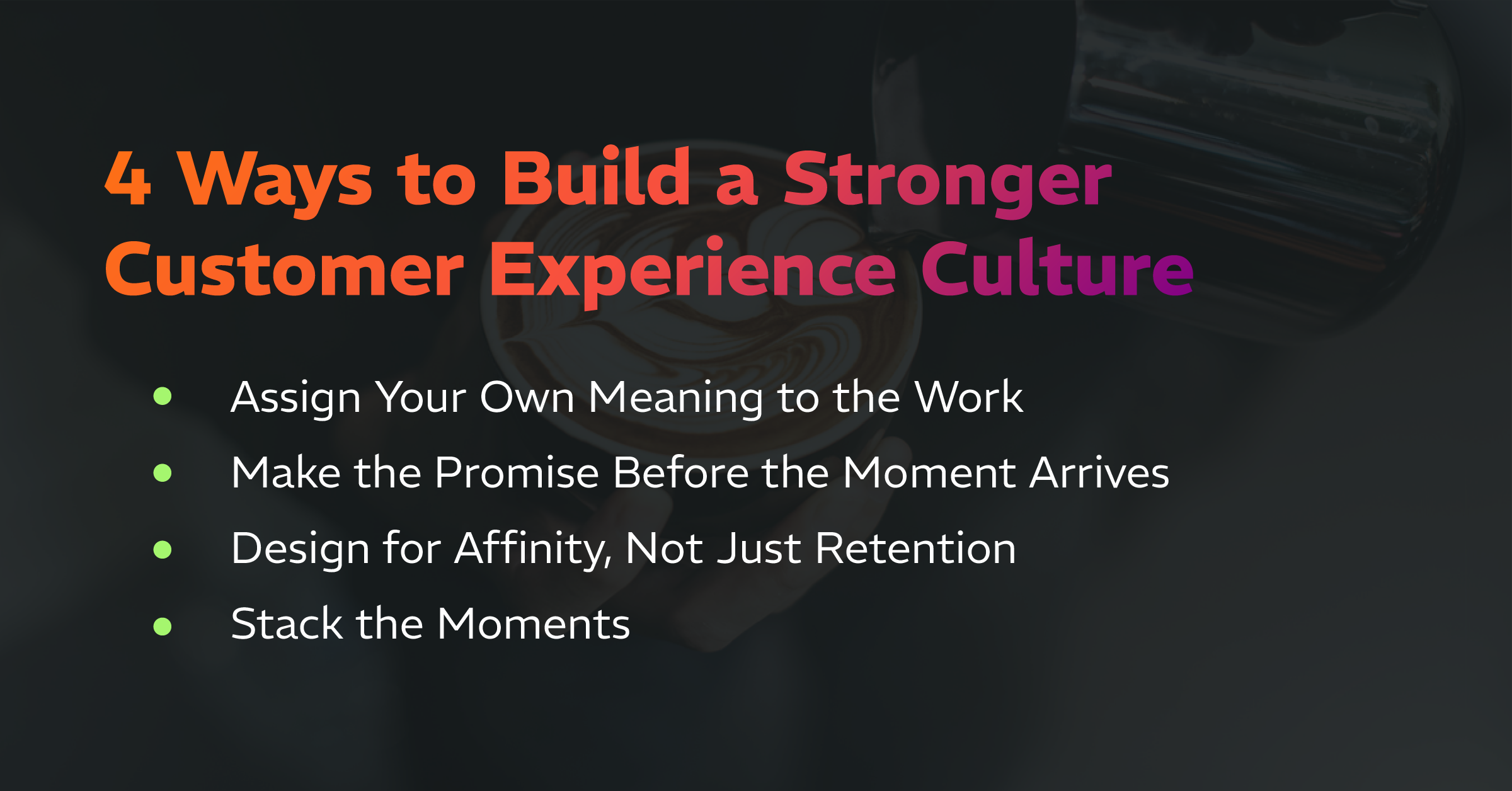
The shift from customer service to customer experience isn’t a training program. It’s a philosophy change, and it starts with four decisions.
Make the Promise Before the Moment Arrives
A brand is a promise that creates an expectation around an experience. Every touchpoint across the customer journey is either a fulfillment of that promise or a breach of it. Most CX breakdowns happen not because frontline employees don’t care, but because the promise was never clear enough for every function that touches the customer to honor it. Sales makes a promise. Delivery inherits it, and support resolves the gap when it isn’t kept. A customer-centric mindset has to run through every one of those handoffs, not just live in the team with “customer” in its name.
Design for Affinity, Not Just Retention
There is a meaningful difference between a customer who stays because switching isn’t worth the friction and a customer who stays because they don’t want to leave. The latter is what I’d call brand affinity. It’s the relationship I have with Delta Airlines, with my financial advisor, with any brand that has consistently delivered on its promise. Customer loyalty is the floor. Long-term affinity is what a customer experience strategy is actually building toward, and the gap between those two outcomes is where most organizations leave growth on the table.
Stack the Moments That Create Value
No single interaction builds that kind of relationship. Micro-moments do. Winning each one and stacking them over time is what moves a customer from satisfied to someone who will not only stay but advocate. Consistency is the strategy. It’s the most reliable way to improve customer experience over time. That’s how you create value in every customer interaction, not in the big moments but in the small ones, every time.
Leave Space for Your People to Assign Meaning to Their Work
The best customer experiences go beyond following a policy. They come from a person who went beyond the transaction. Lily Olson, the Starbucks barista whose pouring happiness approach has been viewed nearly 100 million times, didn’t wait for a job description that told her to care. She invented one. Give your team permission to do the same.
Build a Customer Experience Advantage
Good customer service keeps customers from leaving. Great customer service keeps them from wanting to. But a customer experience strategy does something neither can: it makes customers want to bring others with them. They talk about you on social media, in peer conversations and in the rooms you’d never reach through advertising.
That difference lives in the decisions your organization makes before a customer ever needs anything. It lives in the promise your brand makes and whether every team delivers on it, interaction by interaction, until the relationship becomes something worth staying for.
If you’re ready to bring that philosophy to your organization, The Art of Standing Out is the keynote that starts that conversation.