

Walk into most boardrooms and ask about customer experience digital transformation, and you’ll hear about platforms, integrations, and roadmaps.
Ask an actual customer and you’ll hear something very different:
- “Why do I have to re-enter my information every time?”
- “Why can I order in two clicks but can’t get a real person when something goes wrong?”
- “Why do they know so much about me but still send irrelevant offers?”
That gap is why so many CX transformations disappoint. The tech changes, but the experience doesn’t really improve because vision, ownership and adoption aren’t aligned along the full journey.
However, when we lead with human-centered leadership principles, digital transformation stops being a “tech project” and becomes a growth engine that empowers people, earns loyalty and creates lasting impact.
What Is Customer Experience Digital Transformation?
Customer experience digital transformation is the disciplined use of digital capabilities to fundamentally change how an organization understands, serves, and interacts with customers so the experience improves and business outcomes move with it.
It’s not about adding more channels. It’s redesigning the work behind the experience so value is easier to access, delivered more consistently, and sustainable across the full customer lifecycle. In enterprise environments, that usually means:
- Reinventing journeys end-to-end (evaluate → buy → onboard → adopt → renew → expand), not digitizing isolated steps.
- Connecting touchpoints into one seamless experience (social media, web, mobile, chat, phone, in-person) so a customer can start in one place and continue in another without losing context.
- Building shared customer context (data, governance, workflows) so teams can recognize customers, remember history, and respond in real time.
- Shifting ways of working (operating model, decision rights, change management) so the new experience actually sticks.
Aligned around shared customer and commercial outcomes, digital CX becomes a core driver of sustainable competitive advantage and enterprise value.
How Digital Transformation Is Driving Customer Experience
Customer expectations have changed. We’re in an era where people want instant answers, personalized experiences and the ability to move fluidly between channels without losing context. They don’t think in terms of “digital” versus “physical.” They just expect it all to work.
A handful of key trends are raising the standard for speed, relevance and continuity.
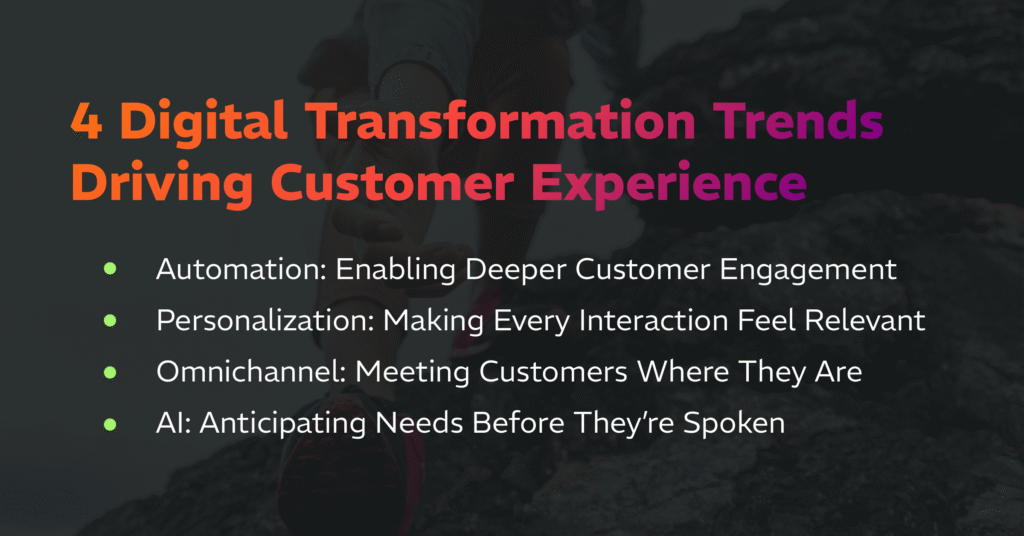
Automation: Enabling Deeper Customer Engagement
The best automation doesn’t replace the relationship. It removes the low-value friction that gets in the way of it.
Smart automation handles routine needs quickly and consistently, with clean handoffs when a situation requires judgment. Your team members shift their time away from busywork and toward the moments where empathy, creativity, and ownership actually matter.
Personalization: Making Every Interaction Feel Relevant
Personalization has matured. Customers aren’t impressed by seeing their first name in an email. They want to feel like you understand their situation.
The goal is to make interactions more useful and more relevant. Share resources that help customers get value from what they’ve already invested in. Surface the next best step based on where they are in the lifecycle. Reach out when customer behaviors suggest they’re stuck, not when your cadence says it’s time.
That’s what a customer-centric mindset looks like in practice: Using what you know about them to create value, not noise.
Omnichannel: Meeting Customers Where They Are
From the inside, we see channels. From the outside, customers see one brand.
Someone might ask a question in chat, receive an email follow-up, pick up the phone when things get complicated, and eventually show up in person. If each touchpoint feels like starting over, you’ve added complexity to their life. If it feels like one continuous, coherent relationship, you’ve earned the right to keep the relationship.
That’s what meeting customers where they are looks like in practice.
AI: Anticipating Needs Before They’re Spoken
AI and predictive analytics can surface patterns humans miss, flag churn risk, suggest next-best actions and highlight opportunities to deliver more value. Used thoughtfully, AI can help your people make better decisions and show up more prepared in the moments that matter.
But AI will scale whatever values and behaviors you reward. If you use it to push harder, send more, and chase short-term revenue, customers will feel that. If you use it to remove friction, anticipate needs, and provide timely, relevant support, they’ll feel that instead.
Technology can accelerate a great experience, but it can’t substitute for the human touch.
Where Digital Transformation and Customer Experience Go Wrong
McKinsey’s research suggests transformations fail about 70 percent of the time. Most failed digital initiatives don’t collapse because the technology doesn’t work. They struggle because they were never designed around the human experience in the first place.
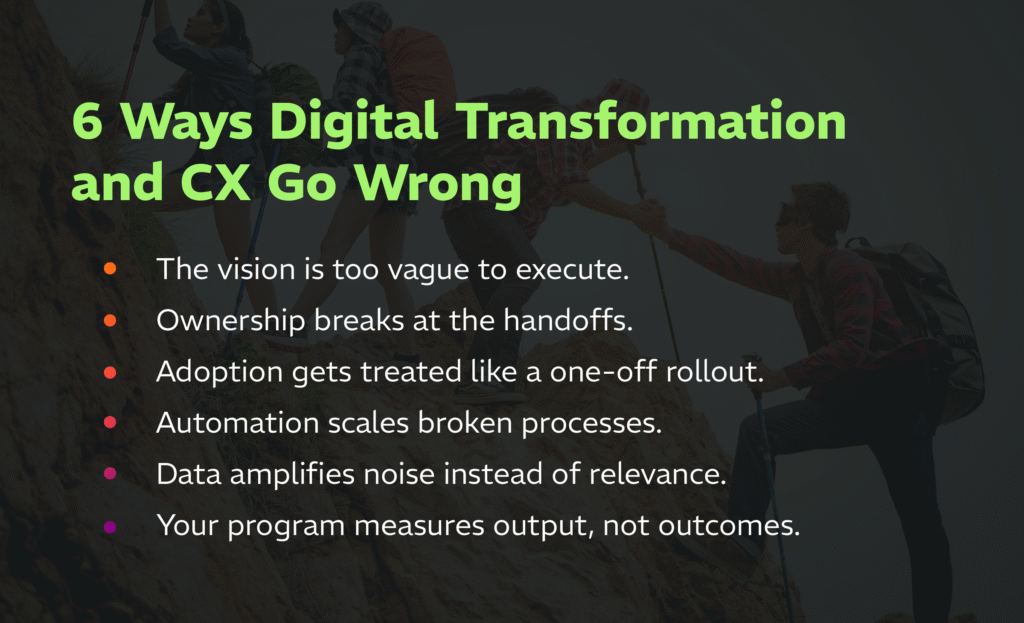
- The vision is too vague to execute. “Improve CX” is not a target state. If leaders do not define what “better” looks like, siloed teams optimize what they can control and the experience stays uneven.
- Ownership breaks at the handoffs. When ownership is unclear, continuity suffers and customers pay for it in repeats, inconsistent answers and messy escalations.
- Adoption gets treated like a one-off rollout. New digital tools do not necessarily create new behavior. If capability building, reinforcement and accountability are light, adoption becomes optional.
- Automation scales broken processes. Automation should remove low-value effort. But when it’s speeding up broken workflows, it scales up the pain points with “self-service” dead ends that cannot resolve the issue.
- Data amplifies pressure instead of relevance. Having customer data is not the same as leveraging it to earn trust. When “personalization” is only used for retargeting and upselling, customers feel disrespected, not seen.
- Your program measures output, not outcomes. Releases, dashboards and feature adoption can all trend up while customer effort, time-to-resolution and retention stay flat.
Why a Strong Digital Customer Experience Is a Competitive Edge
In almost every industry, products are easy to copy. Features can be matched. Pricing can be undercut. Competitive advantages that used to last for years now evaporate in months.
But the way customers feel when they work with you? That’s harder to replicate.
When you consistently deliver digital customer experiences that are clear, responsive and human, loyalty deepens. Customers who feel valued stick around longer. They give you the benefit of the doubt when you make a mistake. They come back, and they bring others with them.
When you understand what customers actually need and align your solutions accordingly, you don’t have to push as hard. That’s the essence of value selling and creating value in sales.
Operationally, efficiency and empathy begin to coexist. Digital transformation is often justified on cost savings alone, but the real power shows up when automation and AI take care of repetitive tasks so your people can focus on high-empathy, high-impact moments that technology can’t replicate.
And in a crowded market, you start to stand out in ways that are hard for competitors to mimic. Was it easy to do business with you? Did someone take accountability when things went wrong? Customer experience becomes your brand. It’s how people tell your story when you’re not in the room.
How to Lead a Successful Human-Centered CX Transformation
Human-centered CX transformation requires clear direction, shared ownership and the operational follow-through that turns new capabilities into new behaviors.
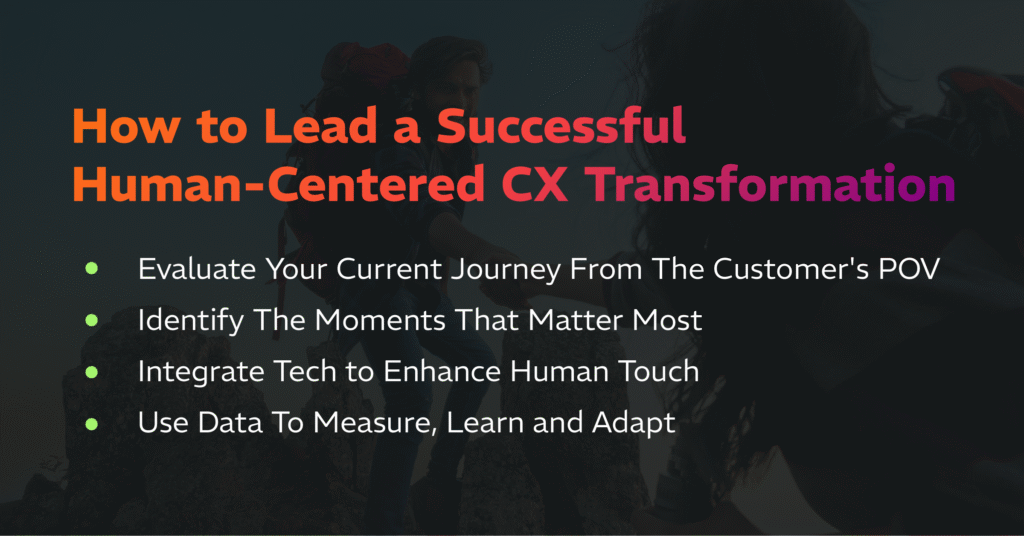
Evaluate Your Current Journey From The Customer’s POV
Most digital transformation journey maps are built from the inside out. They mirror the org chart more than they mirror reality.
Flip that perspective.
Sit in the customer’s seat and walk the journey step by step. Notice how you find the company, what the first interaction feels like, where things get confusing or slow, and what happens when something goes wrong. Don’t guess. Listen to the words customers use in surveys and social channels. Talk to frontline employees. Observe real interactions.
If you were the customer, would you describe this experience as helpful or confusing? Human or transactional? The gaps you uncover are not failures. They’re the drivers of your CX transformation roadmap.
Identify The Moments That Matter Most
Not every interaction carries the same weight.
Some touchpoints are routine. Others are defining. These “moments that matter” are the places where your response has an outsized impact on how customers feel about you.
Think about a new client’s onboarding, the first time a customer needs real support, the renewal conversation after a challenging year, or the proactive check-in when usage suddenly drops. In those moments, technology can provide context and insight, but it’s the human connection that changes the story. Those are the places to prioritize when you’re investing in new tools, training, or process redesign.
Integrate Tech to Enhance Human Touch
Once you know where the experience breaks down and which moments matter most, you can be more intentional with technology.
Use automation for what it does best: handling repetitive, low-stakes tasks quickly and accurately. Use AI to surface patterns and insights that help your people show up more prepared. Use data to tailor how and when you engage, so interactions feel timely instead of intrusive.
At the same time, resist the urge to script and systematize everything. Leave room for judgment and flexibility. Leave room for a human being to read the situation and respond accordingly.
Use Data To Measure, Learn and Adapt
Customer experience is never “done.”
As you evolve your digital strategy, build in feedback loops. Track the metrics that matter for your business, such as NPS and CSAT, and pair those numbers with the stories behind them. When the data signals friction, don’t ignore it. Go deeper. Talk to customers. Talk to employees. Adjust the journey. Test, learn, and iterate.
The best organizations treat customer experience like a living system. It adapts as customers change, as markets shift, and as new technology becomes available.
Empowering Human Connection at Enterprise Scale
Is your digital transformation strategy making it easier for customers to connect with you — or harder? Is it designed to extract value from people — or create value for them?
The answer will determine whether you build a brand people love, or one they simply tolerate until something better comes along.
If you’re ready to reimagine your customer experience through a human-centered lens, this is the conversation to bring into the room with your team.
Explore how my customer experience keynote can help your organization rethink digital transformation, stand out in a crowded market and create customer relationships that actually last.