
A consultative sales approach is how great sellers turn conversations into collaboration.
The challenge? A lot of “sales conversations” aren’t conversations at all. In the rush to prove value, sellers jump straight to the pitch and skip the most crucial step: showing the customer you understand them.
Modern buyers can feel that disconnect. They’re overloaded with information. What they don’t have is tailored insight. According to Salesforce’s State of the Connected Customer report, 86% of buyers are more likely to buy from sellers who understand their goals, yet 59% say most reps don’t take the time to do this. They need partners who can listen, interpret, and co-create value.
Top performers know that simply being “consultative” isn’t enough. They are expanding their impact to become trusted advisers who help customers make better decisions, faster.
What Is a Consultative Sales Approach?
At its simplest, a consultative sales strategy is a shift from selling to a customer toward solving with a customer.
It’s a conversation built on curiosity, not a script built on persuasion. The goal is to understand what the customer is trying to achieve and align your recommendations around that shared outcome.
The salesperson acts as a guide and adviser. They ask thoughtful questions, listen with intent, and tailor every recommendation to the customer’s goals. Trust grows because the conversation is grounded in relevance, not rhetoric or pushing people through a “pipeline.”
Consultative selling itself isn’t new. What’s changed is the customer. Buyers today are more informed, more connected, and more impatient. They expect every interaction to add value. That means sellers need to show up with a point of view—perspective or insight that helps the customer see something they haven’t considered yet.
Consultative Selling vs. Other Sales Models
Every sales model had a purpose when it was developed. Understanding where consultative selling fits in that evolution and how it connects to modern sales techniques, helps clarify why it’s so powerful, especially when you consider consultative selling vs transactional selling. It also reveals where it can fall short if you stop there.
Sales Model | Customer Experience | Salesperson’s Role |
| Transactional Selling | Low personalization, price-driven | Order taker |
Solution Selling | Moderate personalization, product-focused | Problem solver |
Consultative Selling | High personalization, trust-driven | Advisor and collaborator |
Value-Based Selling | Deep partnership, insight-led | Strategic partner |
Consultative selling earns trust because it puts the customer first. But goes a step further by connecting that trust to business impact.
That’s the direction modern selling is headed: beyond understanding problems to shaping outcomes together. Consultative selling is the foundation for building a value-based selling approach grounded in trust.
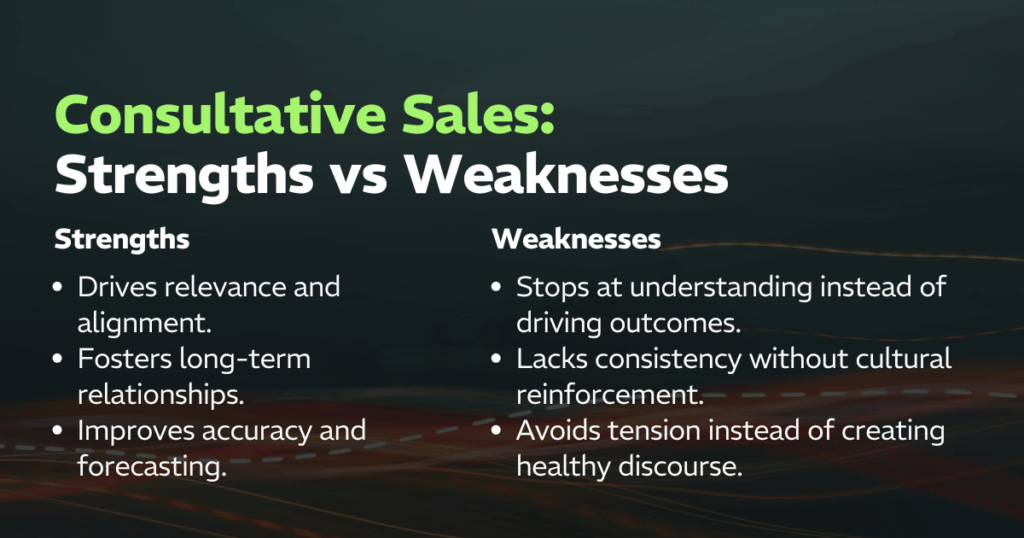
Strengths and Weaknesses of the Consultative Sales Approach
No sales model is perfect, and consultative selling is no exception. Here’s what consultative selling does exceptionally well, and where the approach can break down if sellers and leaders aren’t intentional.
Strengths
- Drives relevance and alignment. Because every recommendation grows from discovery, tailored solutions feel personalized, not prescribed. That shifts the conversation from “What are you selling?” to “How can you help us move forward?”
- Fosters long-term relationships. Consultative selling builds credibility that lasts beyond one deal. When customers perceive you as a partner, renewal, referral, and advocacy follow.
- Improves accuracy and forecasting. When discovery is done right, surprises disappear. Sellers who understand the real decision drivers and the priorities of each decision maker see fewer stalled deals and stronger pipelines.
Weaknesses
- Stops at understanding instead of driving outcomes. Too often, consultative selling ends once the customer’s needs are identified. Top performers go further, connecting empathy to measurable business impact. Understanding is essential. Action is what earns trust.
- Lacks consistency without cultural reinforcement. A consultative approach requires ongoing coaching and reinforcement, not just one-time training. Without sales leadership modeling the behavior, it shows up as a tactic instead of a standard. Human-Centered Growth helps embed those behaviors into culture and cadence.
- Avoids tension instead of creating healthy discourse. Consultative sellers sometimes over-index on empathy and shy away from hard conversations. But growth often happens in moments of healthy tension — when a trusted advisor challenges assumptions and helps the customer see a new path forward.
The consultative approach to sales remains a vital foundation. It humanizes selling and builds trust in a noisy marketplace. But trust alone isn’t enough. The next phase is translating understanding into impact.
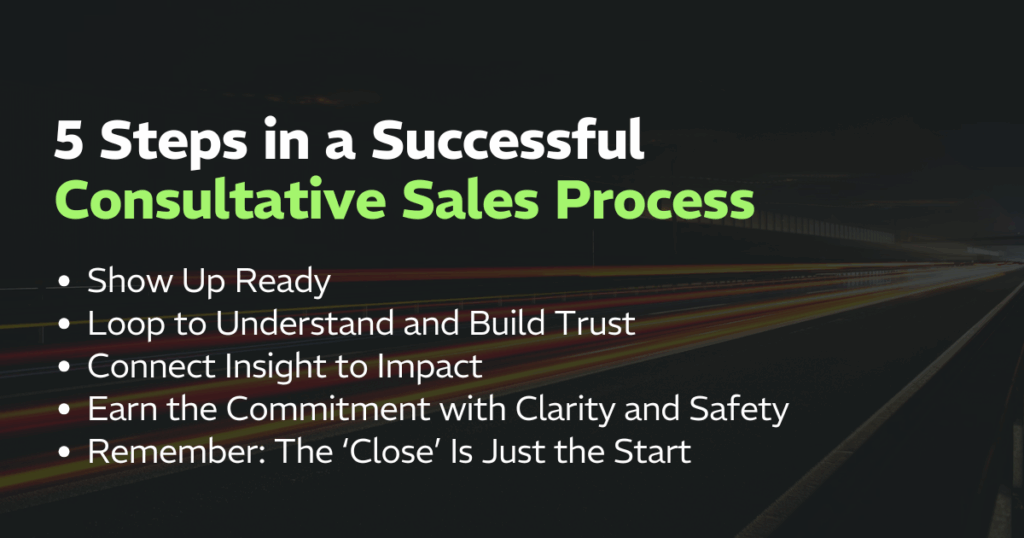
5 Steps in a Successful Consultative Sales Process
Consultative selling is a rhythm anchored in preparation, presence, and purpose. It’s how top sales professionals move beyond a pitch and into a real partnership with the customer.
Here’s how they bring that rhythm to life every day.
1. Show Up Ready
Most deals are won or lost before the sales call even starts. The best salespeople don’t just show up — they show up ready.
That means real pre-call planning: understanding the customer’s business model, market pressures, competitive landscape, and where they are in the decision cycle. You’ve defined your outcome objective. You know who’s in the room, what they care about, and what a successful next step looks like.
Preparation isn’t “admin work.” It’s your performance edge. It signals that you respect the customer’s time and that you’re committed to creating value from the very beginning.
Great discovery starts before the first question is ever asked. Top performers enter the conversation already grounded in understanding the market.
2. Loop to Understand and Build Trust
Listening is a skill—and a differentiator.
Top performers don’t just hear the words and move on. They loop to understand: ask, probe, and then summarize back what they heard for clarity and alignment.
Customers are always signaling priorities, politics, and pain points between the lines. When you reflect those signals back—“Here’s what I’m hearing, and here’s what that tells me”—you build trust, reduce misunderstanding, and keep everyone on the same page.
That one competency alone can improve sales performance exponentially.
3. Connect Insight to Impact
Understanding is the starting point. Impact is the outcome.
Once you have a clear picture of the customer’s situation, your job is to connect the dots between their goals and your solution. That’s where you move from being helpful to being indispensable.
Instead of walking through a feature list, you’re saying:
- “Here’s how this helps you protect margin.”
- “Here’s how this supports your growth targets.”
- “Here’s how this reduces risk for your team.”
You’re selling from a position of intelligence—anchoring your recommendation in their metrics, their mandate, and their reality. That’s how you earn the right to be seen as a trusted adviser.
4. Earn the Commitment with Clarity and Safety
The fear of making the wrong decision is real in nearly every deal.
Even when the value is clear, friction and uncertainty can stall momentum. High performers anticipate that. They simplify the path forward, clarify next steps, and quarterback the commitment.
They make it easy to decide by:
- Aligning stakeholders on decision criteria
- De-risking the choice with proof and story
- Being challenge-ready when objections show up
You’re not pushing. You’re guiding the decision process so the natural and logical conclusion is to move forward together.
5. Remember: The ‘Close’ Is Just the Start
Top performers stay present after the sale. They check in on outcomes. They measure against the commitments that were made. They keep showing up with ideas, insight, and support that help the customer navigate what’s next.
That post-sale presence turns customers into advocates. It’s how you move from a one-time transaction to a long-term partnership—and how consultative selling evolves into value-based selling over time.
Consultative Sales Example
Chris, an account executive for a financial software company, was meeting with Evelyn, the CFO of a logistics firm expanding into new markets. Instead of starting with a sales pitch that Evelyn has likely heard in one form or another a dozen times, Chris asked, “What’s the biggest challenge you’re navigating this quarter?”
That question changed the tone. Evelyn explained that their current system handled accounting well enough, but her team spent days consolidating reports across currencies. What she really needed was faster and clearer insight into how the business was performing in real-time.
Chris didn’t rush to deliver the demo. He listened, clarified, and reframed — a true example of consultative sales driving the sales cycle. The software was a means to Evelyn’s goals, not an end in itself.
That simple shift turned the conversation from technology to strategy. Evelyn leaned in. Chris then demonstrated how their platform could forecast market expansion costs in minutes, aligning directly with the CFO’s stated priorities of speed, visibility, and control.
This is what modern consultative selling looks like: relationship building that leads to relevance, and curiosity that creates clarity. The best sellers help their future partners see what’s possible.
Coaching Your Team Toward Consultative Selling
You don’t build a consultative sales team with one training, a new slide deck, or a motivational speech at kickoff alone. You build it in the rhythm of how you coach, every single week.
If you want your team to sell more consultatively, start by changing the way you lead them.
Coach the Behaviors, Not Just the Numbers
Most sales meetings start and stop at pipeline and performance metrics. Those matter. But consultative selling lives inside the actual conversations reps are having with customers.
Pull real calls. Listen to discovery. Review emails and proposals. Then coach around questions like:
- “Where did you show up curious?”
- “Where did you rush to solution?”
- “Where could you have gone one level deeper?”
You’re not micromanaging activity. You’re helping people upgrade how they show up in the moment of truth.
Make Consultative Behaviors Visible
When you see a rep slow down to understand, ask a courageous question, or connect insight to impact, call it out. Share clips. Celebrate the story in your team meeting. Make it clear: This is what good looks like here.
Over time, those stories start to define the culture more than the scoreboard does.
Practice It Before the Stakes Are High
Top performers don’t “wing it.” They rehearse.
Use role plays and deal strategy sessions to practice consultative selling in a low-risk environment. Focus on one skill at a time:
- Running a deeper discovery.
- Looping to understand.
- Earning a clear next step.
Keep it short, focused, and frequent. Ten minutes of intentional practice every week beats one big workshop you never revisit.
Align Your KPIs With the Behavior You Want
If all you reward is short-term wins, you’ll get transactional selling, even from good sales people who know better.
Layer in metrics and leading indicators that reinforce consultative behavior:
- Quality and depth of discovery.
- Multi-threading key accounts.
- Customer outcomes and retention, not just new logos.
When the scorecard supports the sales strategy, the behavior change sticks.
Consultative Sales Training That Sticks
If you’re ready to move beyond transactional thinking and build a culture where consultative selling is the standard, not the exception, start with the Human-Centered Growth Playbook. It maps out a proven framework for modern sales leadership so you can create sustainable growth and real momentum through harmony.
When you’re looking to bring this work to life at your next SKO or sales meeting, the Sell for Impact sales keynote is the next step. It’s a high-energy, practical experience that teaches sales professionals how to apply a consultative, value-based approach in the moments that matter most.




![[RYAN] Featured Image - Consultative Sales Approach](https://ryanestis.com/wp-content/uploads/bb-plugin/cache/RYAN-Featured-Image-Consultative-Sales-Approach-1024x538-panorama-42c09bf12887088a921116094d899f06-.png "[RYAN] Featured Image - Consultative Sales Approach")
![[RYAN] Featured Image - Sales Tactics](https://ryanestis.com/wp-content/uploads/bb-plugin/cache/RYAN-Featured-Image-Sales-Tactics-1024x538-panorama-81064ac25e005c4d692a589e275c338f-.png "[RYAN] Featured Image - Sales Tactics")