

We’re leading in a time defined by disruption. Exhaustion, overwhelm, and uncertainty have become the baseline of work. And in the middle of all that noise, it’s all too easy to let fear take the lead.
When fear takes over, we often tighten our grip. We want control which leads to micro-manging and misalignment. We delay decisions. We communicate from a place of anxiety or defensiveness. We lose confidence. Over time, that fear loop drains our energy, erodes trust, and blocks the flow of creativity and connection high-performing teams depend on.
The best leaders don’t avoid fear. They know fear is a signal, an invitation to pause, reflect, and reset with greater clarity — and ultimately, to uncover opportunity. That shift isn’t soft. It’s Human Centered. It’s the foundation of confident decision-making, resilience and the catalyst for innovation. which is just the kind of leadership our teams need in times of crisis and complexity.
Understanding The Fear Loop
When fear shows up in leadership, it rarely announces itself.
Instead, it hides behind over-preparation, perfectionism, or the instinct to control every outcome. Beneath the surface, it’s usually ego — a belief system that perceives through judgment, comparison, and scarcity.
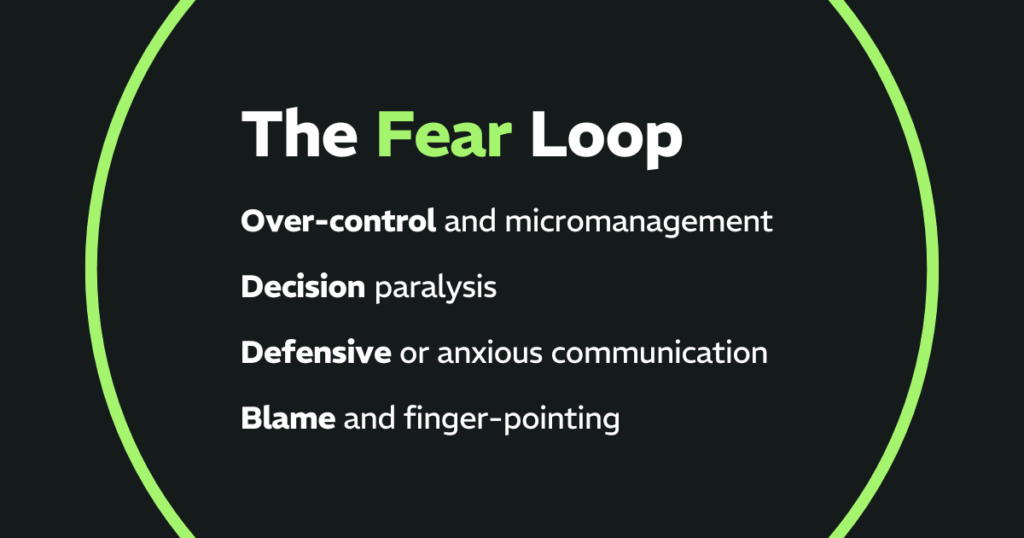
When ego takes the wheel, it pulls us out of the present moment and into judgment, defensiveness, and overthinking. That’s what I call the Fear Loop, a cycle where fear drives control, control fuels overwhelm and exhaustion, which only serves to reinforce fear.
You can see the Fear Loop play out in organizations every day:
- Over-control and micromanagement. When leaders feel anxious about results, they tighten their grip. Meetings multiply. Decisions slow down. People stop taking initiative because they’re waiting to be told what to do. The result is the illusion of control, which actually erodes accountability and engagement.
- Decision paralysis. In times of uncertainty, fear convinces us to wait for perfect information before acting. The truth is, perfect information rarely comes. Great leaders make the best decision possible with what they know now and course-correct as they go. Indecision drains momentum faster than a wrong move.
- Defensive or anxious communication. When leaders communicate from fear, tone and energy shift. Conversations become guarded. Feedback feels risky. People start managing optics instead of outcomes. Over time, this creates distance and destroys trust — the very thing teams need most in times of change.
- Blame and finger-pointing. Fear thrives in environments where people protect themselves instead of the mission. When something goes wrong, energy shifts from solving the problem to assigning fault. Teams that stay in that space lose learning, collaboration, and the chance to adapt quickly.
Fear and ego aren’t the enemy. They’re simply signals. When leaders can see the loop clearly, they can choose a different response. Awareness creates the space for clarity. And clarity is what breaks the cycle.
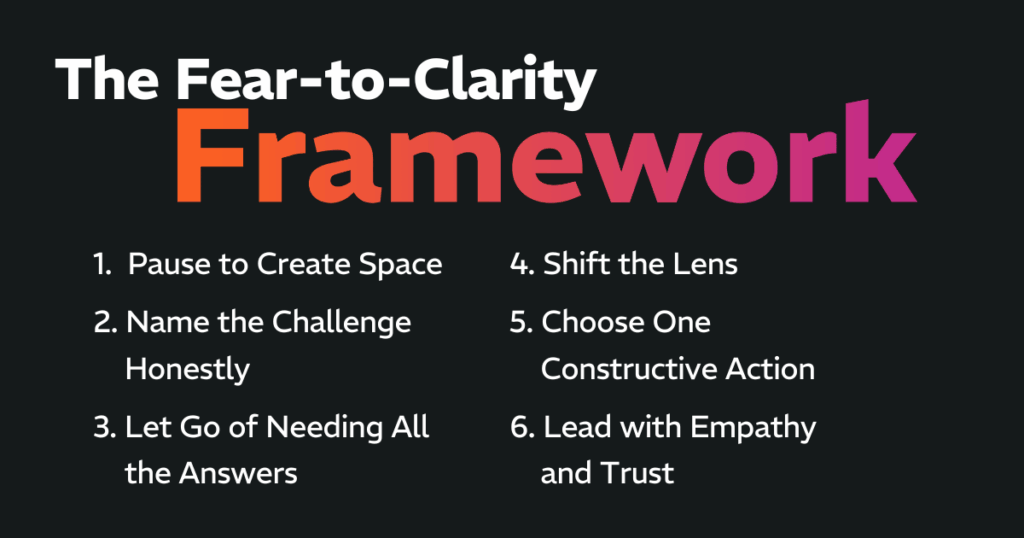
The Fear-to-Clarity Framework: 6 Steps to Shift Perspective
Leading through uncertainty demands more than composure — it demands awareness. Fear doesn’t disappear just because we understand it; we have to notice it in real time and learn how to move through it. That’s where this framework originated. It’s six simple moves that leaders can practice to break the fear loop and return to clarity.
1. Pause to Create Space
A brief pause between stimulus and response is where intention forms and better choices begin.
It sounds small, but it’s everything. Fear rushes the process. It pushes us to fill silence, to react, to do something — anything — just to feel in control.
The pause is how we take control back. It’s the moment to breathe, to come back to center, and to decide what kind of leader we want to be in the next five minutes. It’s a micro-moment — a small but strategic reset that creates space between stimulus and response and gives access to better thinking.
Skip this step, and you’ll end up leading from tension and reactivity. Take it, and you start to reclaim calm. Clarity lives in that space between stimulus and response.
2. Name the Challenge Honestly
Fear exaggerates risk and turns challenges into catastrophes. Naming what’s real brings proportion back to the moment.
This is where transparency matters. Call the challenge what it is — clearly and without exaggeration. Facts replace assumptions. Clear language aligns people around what’s real and removes the noise of worry, speculation and catastrophizing.
What we avoid naming, we empower.
3. Let Go of Needing All the Answers
This is where ego shows up. We equate leadership with certainty, as if credibility depends on always knowing what comes next. But the future hasn’t been defined yet. It’s unfolding in real time, and the most effective leaders are comfortable leading from that space.
Letting go of having all the answers doesn’t mean you stop leading. It means you start leading differently, with questions instead of control. What are we not seeing? What if we tried this? Curiosity opens up possibilities.
Curiosity opens perspective. Ask questions that invite contribution and expand possibilities like, what opportunity are we not seeing?
4. Shift the Lens
Every challenge contains an opportunity.
Fear keeps our focus narrow on the threat, the risk, the thing that might go wrong.
Reframing turns limitation into creative thinking and forward motion. Clarity widens the frame. It invites new questions: Where’s the opportunity here? What if the rules weren’t fixed? What if we tried something new?
When we shift the lens, energy changes. People stop guarding and start contributing. The conversation moves from what’s wrong to what’s possible. That shift brings creativity back online and that’s where innovation begins.
5. Choose One Constructive Action
Fear loves overthinking. It tells us to wait until we’re sure, until the conditions are right, until the plan is perfect. But momentum builds clarity, not the other way around.
Focus on the next play. Progress doesn’t have to be dramatic; it just has to start. Each small step restores confidence and proves that momentum lives in the present, not the past.
Momentum builds confidence. Progress starts with the next step, not the perfect plan. Action mitigates anxiety.
6. Lead with Empathy and Trust
The final step is about presence. Fear isolates; clarity connects. When leaders operate from empathy and trust, they create steadiness for everyone around them.
Empathy doesn’t mean having all the answers. It means understanding how people feel in uncertainty and leading them through it with honesty and calm. Trust isn’t built in speeches; it’s built in those moments when people see you grounded, composed, and real.
Grounded presence steadies teams. Calm, transparent communication creates safety and keeps people aligned and making forward progress.
When leaders use the framework in real time, energy shifts. Communication becomes cleaner, decisions come faster, and teams regain momentum. That’s how clarity takes hold — through practice, presence, and consistent application.
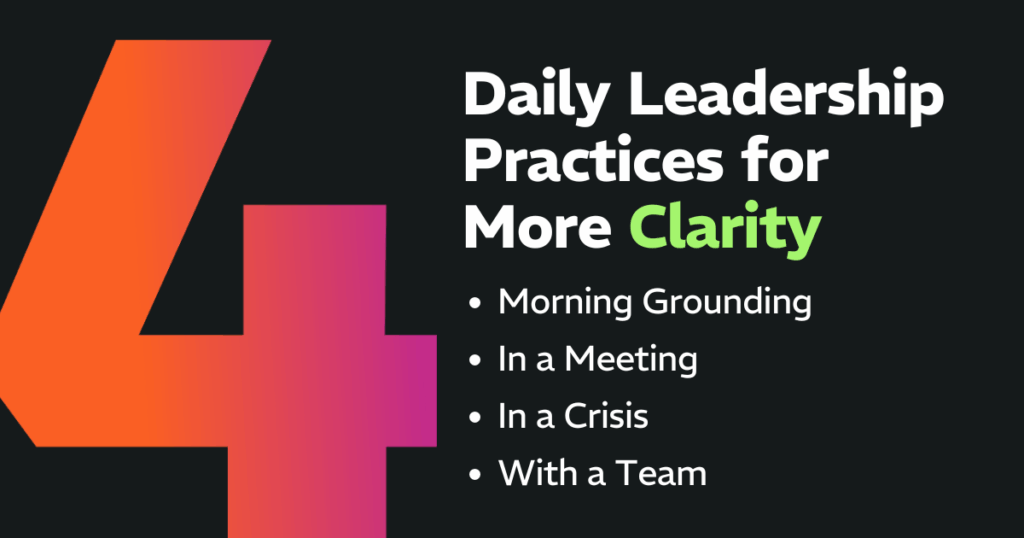
Daily Leadership Practices for Greater Clarity in Uncertainty
Clarity becomes easier to access when it’s part of a daily rhythm. Small, consistent habits keep leaders grounded and steady when the pace of work accelerates. The goal is to embed the mindset until it becomes reflex, a quiet discipline that shapes how decisions are made, conversations unfold, and teams move together.
Morning Grounding
Begin the day by setting the intention. A simple reminder helps align focus: The work today is to create clarity. A few minutes of intentionally moving into presence can steady the tone for everything that follows.
In a Meeting
When tension builds or conversation narrows, pause and ask: What opportunity might we be overlooking? The question redirects attention toward curiosity and possibility, often unlocking the next idea or solution.
In a Crisis
When decisions feel heavy, simplify the field of view. Identify one constructive action that can be taken now. Movement restores confidence and momentum.
With a Team
Communicate with transparency and empathy. Acknowledge challenges, reinforce trust, and keep dialogue open. Listen. When people feel seen, understood and informed, uncertainty loses its edge.
These practices don’t require extra time — only intention. Practiced consistently, they cultivate the composure, focus, and connection that define clarity in leadership.
Choosing Clarity
Fear shows up for every leader. What defines great leadership is the ability to recognize it and return to clarity quickly.
The framework is a way to restore focus and steadiness when circumstances change. It’s built in small moments: a pause before reacting, an honest conversation, a question that opens up a new perspective.
Apply it once this week. See what shifts in tone, in energy, in the way decisions move forward.
Fear shows up for every leader. It often signals where growth and opportunity live and clarity is the way forward through it.
Turn Fear into Focus with the Right Tools
Great leadership in times of uncertainty starts with awareness, clarity, and human connection. The Human-Centered Growth Playbook offers practical frameworks to help you break the fear loop, lead with confidence, and build momentum — even in the face of disruption.
Download the Playbook and start shifting from reaction to resilience today.